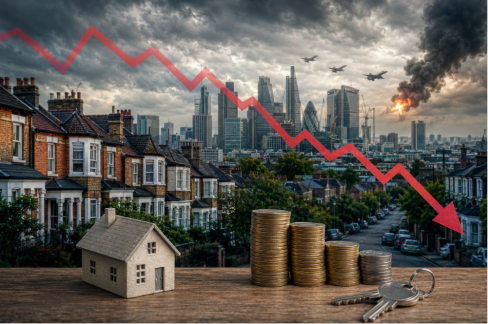
The UK housing strain is becoming more visible as uncertainty around the Iran conflict impacts confidence across England and Wales. Estate agents report slower activity, falling buyer inquiries, and growing concern over mortgage affordability. Rising oil and gas prices linked to the Middle East crisis are also increasing fears of higher inflation and interest rates.
Many households now hesitate before making major property decisions. Buyers worry that borrowing costs could rise further, while sellers fear they may not achieve expected asking prices. As a result, the market has entered a more cautious phase during 2026.
According to the latest survey from the Royal Institution of Chartered Surveyors, estate agents across the country have seen demand weaken sharply. The slowdown highlights how global geopolitical events can quickly affect everyday financial decisions in the UK property sector.
UK Housing Strain Reduces Buyer Demand
First, the latest figures show a clear decline in buyer activity. A net balance of 34% of estate agents reported fewer inquiries from new buyers in April. Although this was slightly better than March’s 40% decline, it still points to a sluggish market.
Agreed property sales also continued to fall. A net 36% of survey respondents reported lower sales volumes compared with previous months. Importantly, many agents do not expect conditions to improve significantly during the next quarter.
Several factors explain this hesitation. Inflation fears remain high, and mortgage lenders continue adjusting rates in response to financial market volatility. In addition, many families worry about future household costs if energy prices rise further.
The uncertainty surrounding the Iran conflict has therefore added another layer of pressure to an already fragile market environment.
UK Housing Strain Pushes Prices Lower
House prices are now facing downward pressure in several regions. More estate agents reported falling prices than rising ones during the past three months. A net balance of 34% saw values decline, indicating weaker momentum across the market.
London and southern England appear particularly vulnerable. Regions including the south-east, East Anglia, and the south-west reported some of the weakest readings in the survey. High property prices in these areas make buyers especially sensitive to changes in borrowing costs.
Meanwhile, northern regions showed slightly stronger resilience. Areas such as the north-west posted modestly positive readings, suggesting affordability still supports activity outside southern England.
However, even in stronger regions, confidence remains cautious. Many sellers are delaying listings until market conditions become clearer. As a result, the number of newly available homes has remained relatively flat.
This limited supply could prevent dramatic price crashes, but it has not been enough to revive buyer confidence.
UK Housing Strain Linked to Inflation Risks
The Iran conflict continues to influence wider economic expectations. Higher oil and gas prices are feeding concerns that inflation could remain elevated for longer than expected.
The Bank of England has already warned that energy-related inflation pressures may become unavoidable if geopolitical tensions continue. Financial markets have reacted by pushing government borrowing costs higher, which directly affects mortgage pricing.
Swap rates, heavily used by lenders to price fixed-rate mortgages, tend to follow bond yields closely. Consequently, many banks have become more cautious when offering competitive mortgage deals.
For homebuyers, this means monthly repayments may stay higher for longer. Even small rate increases can significantly reduce affordability, especially in expensive housing markets.
Tarrant Parsons, senior economist at RICS, explained that activity and sentiment may remain subdued until inflation and borrowing costs become more predictable. He also noted that London and southern England feel the greatest pressure because property values are already stretched. UK House Prices Rise Despite Global Conflict Concerns.
UK Housing Strain Slows Property Transactions
Large estate agencies have also reported slower transaction activity. Savills said business momentum weakened noticeably after the conflict intensified.
The company reported that first-quarter residential transactions rose only slightly compared with last year. In addition, completion times have become longer as buyers take more time to secure financing and assess market risks.
This “wait-and-see” approach now dominates much of the market. Buyers hesitate because they fear prices could fall further. Sellers hesitate because they hope conditions may improve later in the year.
Consequently, transaction pipelines across England and Wales are moving more slowly than expected at the start of 2026.
UK Housing Strain Contrasts With Rental Demand
Interestingly, the rental sector tells a very different story. Tenant demand remains strong while rental supply continues to shrink.
Many landlords have exited the market due to tighter regulations, rising taxes, and higher mortgage costs. This has reduced the number of available rental properties across several UK cities.
At the same time, more people are postponing home purchases because of affordability concerns. As a result, rental demand continues rising steadily.
RICS data showed a net 14% increase in tenant demand during the past three months. Estate agents also expect rents to continue climbing throughout the year.
For renters, this creates additional financial pressure. Higher rents make saving for deposits more difficult, which may further delay first-time buyer activity. RICS Housing Surveys.
UK Housing Strain Could Continue Through 2026
Looking ahead, the direction of the property market will depend heavily on inflation, interest rates, and geopolitical stability.
If tensions in the Middle East ease, energy markets could stabilise and help improve confidence. However, if the conflict continues, mortgage costs and household expenses may remain elevated.
Northern regions could continue outperforming southern England because of relatively better affordability. Nevertheless, most experts believe the overall market will remain subdued for the near future.
For buyers, patience and careful financial planning are increasingly important. Comparing mortgage products, researching local trends, and understanding affordability limits can help reduce risks.
Sellers may also need to adjust expectations. Realistic pricing and flexibility could become essential in slower market conditions. UK Government Housing Data.

I’m an Online Media & PR Strategist at BusinessFits, passionate about digital storytelling and media impact. As a journalist, blogger, and SEO specialist, I create content that connects, informs, and ranks.