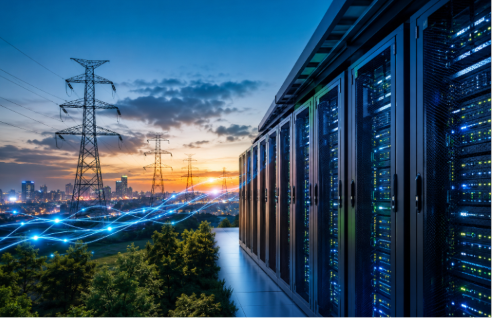
UK Datacentre Power demand is rising faster than many experts expected. New research shows datacentres now consume nearly 6% of electricity supplies in both the UK and the US. The rapid expansion of artificial intelligence, cloud services, and digital infrastructure is driving this dramatic increase.
Only a short time ago, UK datacentres accounted for around 2.5% of national electricity use. Today, that figure has more than doubled. As AI systems grow larger and businesses depend more on digital services, pressure on electricity grids continues to increase.
At the same time, communities and environmental groups are starting to question whether the current pace of expansion is sustainable. Rising energy bills, water consumption, and carbon emissions are becoming major concerns.
Why UK Datacentre Power Usage Is Rising Fast
Datacentres are massive facilities packed with servers, networking equipment, and cooling systems. These systems operate around the clock to support websites, cloud computing, streaming platforms, financial services, and AI models.
The biggest factor behind rising UK Datacentre Power demand is artificial intelligence. Training and running advanced AI systems requires enormous computing resources. Every AI search, chatbot interaction, and machine learning task depends on energy-intensive hardware.
Cooling systems also play a major role. Servers generate large amounts of heat, and operators must keep temperatures stable to prevent failures. In some facilities, cooling accounts for more than 40% of total electricity use.
In addition, companies continue building larger datacentres to meet demand for cloud services and AI tools. Major technology firms are investing billions into infrastructure expansion across Europe and North America.
According to recent estimates, global datacentre investment is approaching $1 trillion annually. That level of spending reflects how essential digital infrastructure has become to modern economies.
UK Datacentre Power Compared With Other Countries
The UK and the US now both allocate roughly 6% of electricity supplies to datacentres. This places them significantly above the global average of around 2%.
However, several smaller countries face even higher levels of consumption. Singapore uses nearly 19% of its electricity for datacentres, while Lithuania sits near 11%.
These numbers highlight how concentrated digital infrastructure can create serious stress on national grids. Smaller countries often experience greater challenges balancing industrial demand with residential energy needs.
Another issue affecting UK Datacentre Power efficiency is wasted energy. Research in the US suggests around 13% of datacentre electricity powers unused or forgotten services, often called “zombie servers.” These inactive systems still consume electricity despite providing little or no value.
If similar inefficiencies exist across global infrastructure, significant amounts of energy could potentially be saved through smarter management.
UK Datacentre Power Creating Grid Pressure
Energy infrastructure in the UK is already under strain. Developers often wait years for new grid connections because electricity networks cannot easily handle rising industrial demand.
As UK Datacentre Power requirements grow, competition for electricity becomes more intense. Households, businesses, transport systems, and renewable projects all depend on the same energy infrastructure.
National Grid operators have warned that electricity demand will continue increasing sharply over the next decade. Government forecasts suggest datacentre power consumption could quadruple by 2030.
At the same time, grid connection queues expanded dramatically during early 2025. This has slowed infrastructure projects and created uncertainty for companies planning new facilities.
Many residents worry these pressures could contribute to higher electricity prices. Others fear shortages during periods of peak demand. International Energy Agency
Environmental Concerns Around UK Datacentre Power
Environmental groups increasingly question the long-term impact of expanding datacentre infrastructure. Greenpeace UK has warned that an “unchecked AI boom” may increase fossil fuel usage and place extra pressure on water supplies.
Cooling systems often require enormous amounts of water, especially during hot weather. In areas already facing water shortages, new datacentres could worsen existing challenges.
Carbon emissions remain another major issue linked to UK Datacentre Power growth. Although many technology companies promise renewable energy investments, critics argue some projects still rely heavily on traditional power generation.
Some campaigners also accuse developers of understating the environmental impact of proposed facilities. As public awareness grows, local opposition to new datacentre projects is becoming more common.
Doug Parr, chief scientist at Greenpeace UK, has called for stronger transparency and clearer environmental assessments before approving large-scale developments.
Security Risks Linked to UK Datacentre Power Infrastructure
Datacentres are now considered critical national infrastructure because modern economies rely heavily on them. Any disruption could affect banking systems, healthcare platforms, communications, and online services.
Recent attacks on datacentres in the Middle East raised concerns about physical security risks. Operators increasingly treat cyber threats and physical attacks as connected challenges.
As UK Datacentre Power demand grows, governments may introduce stricter security standards to protect essential infrastructure. This could include stronger cybersecurity measures, backup power systems, and improved physical protection.
The growing importance of AI services also means outages could affect far more industries than before.
What the Future Holds for UK Datacentre Power
The future of UK Datacentre Power will depend on how governments, energy providers, and technology companies respond to rising demand. Green Energy Switch Drives UK Homes Amid Fuel Surge.
Many experts believe efficiency improvements could reduce waste significantly. Smarter cooling systems, better server management, and energy-efficient processors may help lower electricity consumption.
Some operators are also investing heavily in renewable energy partnerships. However, questions remain about whether renewable generation can expand quickly enough to meet future demand.
Policymakers may eventually introduce stricter rules around energy efficiency and environmental reporting. Communities are also likely to demand greater transparency before approving new facilities.
Datacentres remain essential for cloud computing, AI systems, online services, and digital economies. Yet balancing technological growth with environmental and energy realities will become increasingly difficult over the next decade. AI Payment Systems: Visa Enables Agent Transactions.
Without careful planning, electricity costs could rise further and grid reliability may weaken. The challenge now is ensuring digital progress does not overwhelm national infrastructure.

I’m an Online Media & PR Strategist at BusinessFits, passionate about digital storytelling and media impact. As a journalist, blogger, and SEO specialist, I create content that connects, informs, and ranks.