Russian Submarine Test Launches Nuclear-Capable Bulava
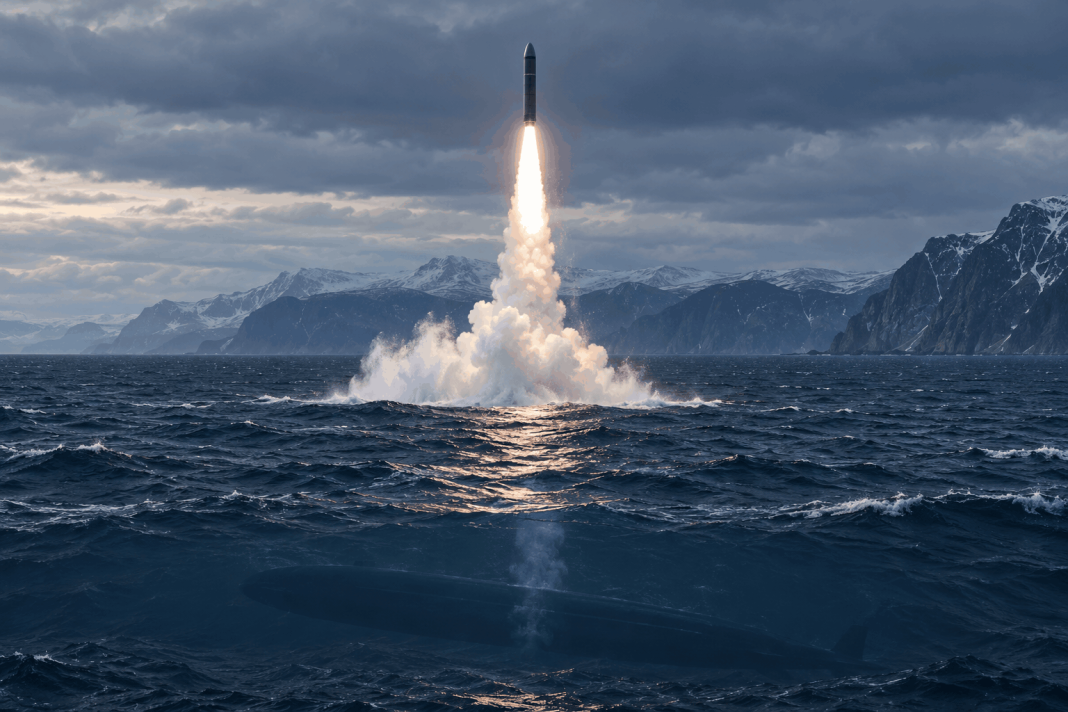
The Russian Submarine Test reported on 28 October 2026 brought Moscow’s sea-based nuclear forces into focus. The strategic submarine Generalissimus Suvorov launched a nuclear-capable Bulava ballistic missile while submerged in the Sea of Okhotsk. Russian defence officials described the firing as a scheduled training exercise involving the Pacific Fleet.
The missile travelled towards the Chizha test range in Russia’s northwestern Arkhangelsk region. According to the defence ministry, its warheads reached the designated area at the expected time. These results remain official claims rather than independently verified findings.
The announcement concerns a missile launch, with no reported nuclear explosion. A nuclear-capable weapon can carry nuclear warheads during operational deployment. However, that description alone does not establish what payload this particular training missile carried.
Russian Submarine Test: What Officials Reported
First, the launch involved a submarine operating beneath the surface in Russia’s Far East. Its target lay across the country in the European north. This westward route connected a Pacific operating area with a distant northern test facility.
The defence ministry released footage alongside its announcement. It said monitoring information showed the missile’s warheads arriving within the calculated timeframe. However, the public statement offered limited detail about the measurements used to assess the flight. Дальний Восток || Интерфакс Россия
That distinction matters when interpreting the reported success. Launch footage can show a missile leaving the water, but it cannot establish every later stage. Assessing performance also requires tracking information, flight records and observations from the target area.
Furthermore, a successful exercise represents one event under particular conditions. It does not establish the reliability of every missile aboard every submarine. Broader conclusions require evidence across repeated trials, maintenance records and operational experience.
Russian Submarine Test: The Borei-A Platform
Generalissimus Suvorov belongs to the Project 955A Borei-A class of strategic nuclear-powered submarines. The vessel entered Russian naval service in December 2022. It subsequently transferred to the Pacific Fleet, reaching its permanent base in Kamchatka in October 2023. AeroTime
Each Borei-A submarine has 16 launch tubes for Bulava ballistic missiles. Nevertheless, that capacity does not confirm the number carried during this exercise. Public reporting about the firing should therefore distinguish the vessel’s design from its undisclosed operational load. armyrecognition.com
Nuclear propulsion and nuclear armament also describe different features. The reactor supplies energy for the submarine’s operation. Meanwhile, its ballistic missiles provide the strategic weapons capability associated with its deterrent role.
For a ballistic missile submarine, remaining difficult to detect supports its ability to survive a conflict. That survival underpins the idea of a retaliatory force. Consequently, discussions about these vessels involve endurance, communications and crew readiness alongside missile performance.
For related coverage, explore our [naval defence technology articles](/?s=naval+defence+technology).
Russian Submarine Test: Understanding Bulava
The Bulava, also known as the RSM-56, is a submarine-launched ballistic missile designed to carry nuclear warheads. Its intercontinental reach places it within Russia’s strategic arsenal. It differs from shorter-range naval weapons intended for nearby ships or coastal targets. AeroTime
The missile uses solid-fuel propulsion and can carry multiple warheads. These broad characteristics explain its strategic importance. However, published design specifications should not be confused with confirmed details about the missile used in this exercise. zona-militar.com
Similarly, an estimated maximum range does not reveal the distance travelled during a particular test. That calculation depends on the actual launch point and flight path. The latest announcement did not disclose enough information to establish those details precisely.
Readers can examine the recorded Bulava test history for additional background. That chronology includes successful launches, failures and entries with disputed outcomes. It provides a wider perspective than a single announcement can offer. Russian strategic nuclear forces
Therefore, the most useful interpretation separates three questions. What can the missile theoretically do? What did officials report about this launch? Finally, what evidence is available for outside assessment?
Russian Submarine Test: Geography and Previous Launches
The Sea of Okhotsk provides the geographic setting for this Pacific Fleet exercise. Meanwhile, the Chizha range lies on the Kanin Peninsula in Russia’s north. The two locations explain why the firing attracted attention as a long-distance westward launch.
Generalissimus Suvorov previously launched a Bulava during acceptance trials in November 2022. On that occasion, it fired from the White Sea towards the Kura range in Kamchatka. The latest reported exercise followed the opposite general direction. Russian strategic nuclear forces
This history helps place the event within the submarine’s development and service record. Acceptance trials assess a vessel before operational handover. Later training allows its crew to practise tasks and demonstrate readiness after entering fleet service.
However, different launches can involve different objectives and conditions. Comparing them solely through a successful or unsuccessful label can overlook those differences. A fuller assessment considers the vessel’s status, the exercise purpose and the information released afterwards.
Russian Submarine Test: Security Implications and Next Steps
Strategic submarine exercises attract attention because they involve weapons built for nuclear deterrence. Such forces aim to preserve a country’s ability to respond after an attack. Training announcements can also communicate military capability to foreign governments and domestic audiences.
However, the launch alone does not establish an immediate change in nuclear policy. Russia described this firing as scheduled combat training. Any claim about a separate political message would require additional evidence beyond the launch announcement.
Next, observers will look for further information about the exercise and its results. Detailed tracking evidence could strengthen assessments of the reported outcome. Additional official statements might also clarify how the event fits into broader fleet training.
Readers following the wider subject can browse our [global security coverage](/?s=global+security). For this event, the central facts remain clear: officials reported a submerged Bulava launch and successful arrival at the designated range. Its wider significance depends on evidence beyond that initial account.

Nuwan Wackwella is a digital creator passionate about technology, creativity, and sharing inspiring moments from everyday life.