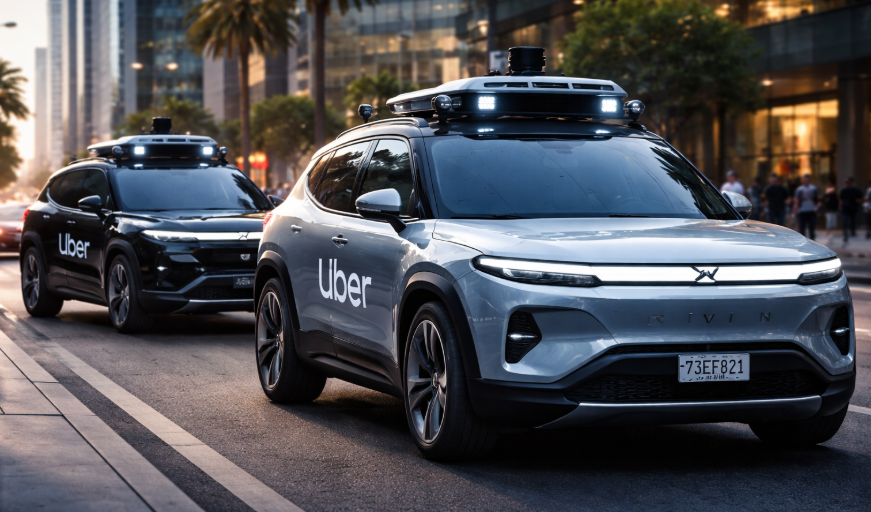
The Uber Rivian robotaxi partnership marks a major turning point in the future of transportation. Ride-hailing giant Uber has joined forces with electric vehicle innovator Rivian to launch a massive fleet of autonomous taxis. This strategic deal is set to redefine urban mobility, combining electric vehicles with advanced self-driving technology.
Announced on March 19, the collaboration signals Uber’s aggressive push into autonomous mobility while giving Rivian a strong foothold in the robotaxi market. With plans to deploy tens of thousands of vehicles, this initiative could soon make driverless rides a daily reality.
Uber Rivian Robotaxi Deal Details and Investment
The Uber Rivian robotaxi agreement includes a significant financial commitment. Uber will initially invest $300 million into Rivian, acquiring millions of shares and strengthening the partnership. Over time, the total investment could reach $1.25 billion, depending on performance milestones.
The deal begins with an order of 10,000 specially designed Rivian R2 vehicles. These vehicles will integrate Rivian’s proprietary hardware and software, optimized for autonomous driving. Uber also plans to expand the fleet by up to 40,000 additional vehicles after 2030.
This long-term investment highlights Uber’s confidence in Rivian’s ability to deliver scalable and reliable autonomous technology.
Uber Rivian Robotaxi Launch Timeline and Expansion
The Uber Rivian robotaxi rollout is scheduled to begin in 2028. Initial deployments will take place in major cities like San Francisco and Miami, where demand for innovative mobility solutions is already high.
From there, the service will gradually expand to approximately 25 cities across the United States, Canada, and Europe by 2031. All rides will be exclusively available through Uber’s app, ensuring seamless user experience and centralized operations.
This phased approach allows both companies to refine performance, improve safety, and scale efficiently.
Uber Rivian Robotaxi Technology and Innovation
At the core of the Uber Rivian robotaxi initiative lies cutting-edge technology. Rivian brings its vertically integrated ecosystem, controlling everything from vehicle design to software development. This gives the company a unique advantage in building optimized autonomous vehicles.
Advancements in artificial intelligence, sensor technology, and real-world driving data have made robotaxis more viable than ever. Rivian’s growing dataset from its existing electric vehicles helps train smarter autonomous systems, improving decision-making and safety.
Meanwhile, Uber contributes its expertise in managing large scale ride sharing networks, ensuring efficient fleet deployment and customer experience.
Uber Rivian Robotaxi Market Impact and Competition
The Uber Rivian robotaxi deal comes at a time when competition in autonomous mobility is intensifying. Companies like Waymo and Lucid Motors are also investing heavily in this space.
Uber has already partnered with multiple players to expand its autonomous capabilities. This latest move strengthens its position and provides exclusive access to Rivian’s technology.
For Rivian, the partnership ensures a steady stream of orders and reinforces its reputation as a serious contender in the EV and AI-driven mobility markets.
Uber Rivian Robotaxi Benefits for Cities and Users
The Uber Rivian robotaxi rollout offers several benefits for cities and commuters. One of the most significant advantages is sustainability. With all vehicles being electric, the initiative contributes to reducing carbon emissions and improving air quality.
For users, the experience becomes more convenient and potentially more affordable over time. Driverless rides eliminate the need for human drivers, which could lower operational costs and increase availability.
Additionally, robotaxis can improve accessibility for people without personal vehicles, offering reliable transportation options in urban and suburban areas.
Uber Rivian Robotaxi Safety and Regulatory Challenges
Safety remains a critical focus in the Uber Rivian robotaxi project. Both companies emphasize rigorous testing using real world data and simulations to ensure reliable performance.
Rivian’s autonomous systems are continuously trained and refined, while Uber brings operational expertise in handling complex transportation networks. Together, they aim to balance rapid deployment with strict safety standards.
However, regulatory challenges still exist. Governments and city authorities will play a key role in approving and overseeing the rollout of autonomous vehicles. Ensuring compliance across multiple regions will be essential for long-term success.
Uber Rivian Robotaxi Financial and Stock Market Reaction
The announcement of the Uber Rivian robotaxi deal had an immediate impact on the stock market. Rivian shares surged nearly 10% in pre-market trading before settling with a solid gain by the end of the day.
Investors see this partnership as a strong revenue opportunity for Rivian, providing long-term stability and growth potential. For Uber, the move signals a strategic shift toward future mobility solutions beyond traditional ride-hailing.
Market analysts believe this deal positions both companies well in the rapidly evolving transportation landscape.
Uber Rivian Robotaxi Future Outlook and Industry Trends
Looking ahead, the Uber Rivian robotaxi initiative represents a broader trend toward autonomous and electric mobility. As technology continues to improve, robotaxis are expected to become a common feature in cities worldwide.
The combination of AI, electrification, and shared mobility is reshaping how people travel. This partnership could accelerate adoption and set new standards for the industry.
While challenges remain, the momentum behind autonomous vehicles is undeniable. Companies that successfully integrate technology, safety, and scalability will lead the next phase of transportation.
Conclusion
The Uber Rivian robotaxi partnership is more than just a business deal it’s a glimpse into the future of mobility. With billions in investment, thousands of vehicles planned, and a clear roadmap for expansion, both companies are betting big on autonomous transportation.
As the rollout begins in 2028, the world will be watching closely. If successful, this initiative could transform how people move, making transportation cleaner, smarter, and more accessible than ever before.

I’m an Online Media & PR Strategist at BusinessFits, passionate about digital storytelling and media impact. As a journalist, blogger, and SEO specialist, I create content that connects, informs, and ranks.