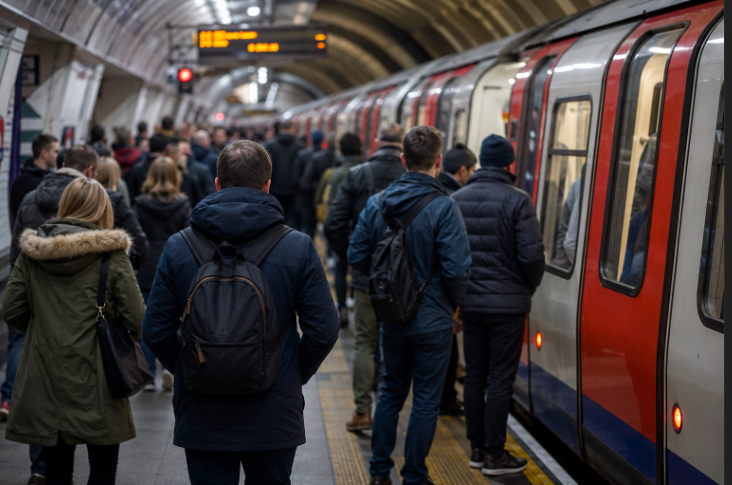
London commuters are preparing for another week of uncertainty as Tube Strike Disruption returns to the capital. The Rail, Maritime and Transport (RMT) union has confirmed that planned walkouts will take place on Tuesday 2 June and Thursday 4 June 2026 after negotiations with Transport for London (TfL) failed to produce an agreement.
The industrial action is expected to affect millions of passengers who rely on the London Underground every day. While some services may continue operating, major disruptions are likely across key routes, forcing commuters to seek alternative travel options.
Why Tube Strike Disruption Is Happening
The latest Tube Strike Disruption stems from disagreements over proposed working arrangements for Underground drivers. At the center of the dispute is TfL’s plan to introduce a four-day working week.
According to the RMT, many members are concerned that compressed schedules could result in longer shifts and increased fatigue. Union representatives argue that driver alertness is essential for maintaining safety across one of the world’s busiest metro systems.
Furthermore, the union claims that employee concerns have not been adequately addressed during negotiations. As a result, members voted to proceed with strike action after talks failed to achieve a breakthrough.
While another rail union accepted aspects of the proposal, RMT members remain unconvinced that the new arrangements sufficiently protect staff welfare and passenger safety.
How Tube Strike Disruption Will Affect London Services
TfL has warned passengers to expect significant interruptions throughout the strike days. Several lines could experience severe reductions in service, while others may not operate at all for extended periods.
Early forecasts suggest the Circle, Piccadilly, Metropolitan, and parts of the Central line will face the greatest challenges. Service availability may change throughout the day depending on staffing levels and operational requirements.
Passengers are advised to complete journeys earlier than usual. Evening travel may become especially difficult as reduced services begin winding down before normal operating hours.
Although TfL will attempt to run as many trains as possible, commuters should prepare for delays, overcrowding, and longer travel times.
Preparing for Tube Strike Disruption During Your Commute
Anyone planning to travel on strike days should make arrangements well in advance. Flexible working options may provide the easiest solution for many employees.
Consider these practical travel tips:
- Check live TfL updates before leaving home.
- Leave extra time for all journeys.
- Consider cycling or walking for shorter distances.
- Use bus and National Rail alternatives where available.
- Download real-time travel apps such as Citymapper.
- Avoid peak travel periods whenever possible.
By planning ahead, passengers can reduce the stress often associated with major transport disruptions.
The History Behind Tube Strike Disruption Disputes
Industrial action on the London Underground is not new. Similar disputes have occurred regularly over pay, pensions, staffing levels, and working conditions.
Earlier in 2026, several planned strikes were suspended after progress was made in negotiations. However, unresolved concerns surrounding shift patterns and work-life balance have now resurfaced.
The disagreement highlights broader challenges facing public transport networks. Operators must balance employee welfare, financial pressures, and service reliability while meeting growing passenger demand.
Consequently, achieving long-term solutions often proves difficult, even after temporary agreements are reached.
HS2 Project Delays Push Costs Beyond £100bn
Economic Impact of Tube Strike Disruption Across London
The effects of Tube Strike Disruption extend far beyond railway stations. London’s economy relies heavily on efficient public transportation to move workers, customers, and visitors throughout the city.
When Underground services are interrupted, businesses frequently experience lower footfall. Retail stores, restaurants, cafés, and entertainment venues often report reduced customer numbers during strike periods.
Office workers may face longer commutes or choose to work remotely. Meanwhile, employers can experience productivity losses as staff struggle to arrive on time.
Tourism also suffers. Visitors unfamiliar with London’s transport network may cancel planned activities or avoid travelling to certain parts of the city altogether.
For a global city that depends on mobility, transport disruption carries significant economic consequences.
Safety Concerns Driving Tube Strike Disruption Debate
Safety remains one of the most important issues in this dispute. RMT leaders insist that longer working shifts could increase fatigue among drivers responsible for transporting millions of passengers.
Union representatives argue that tired operators present unnecessary risks in a safety-critical environment. They maintain that any changes to working practices should be carefully evaluated before implementation.
TfL, however, believes modern scheduling arrangements can improve flexibility while maintaining operational standards. Officials argue that the proposed changes are designed to improve efficiency without compromising safety.
As negotiations continue, both sides insist that passenger wellbeing remains a priority.
What Happens Next After Tube Strike Disruption
Although the strikes are currently scheduled to proceed, negotiations could still resume before the planned walkouts begin. Transport disputes in the UK have often been resolved at the final hour through renewed discussions.
However, if no agreement is reached, commuters should expect disruption on both strike dates. Additional industrial action may also be considered if concerns remain unresolved.
For now, Londoners are encouraged to monitor official announcements and remain flexible with travel arrangements.
Managing Tube Strike Disruption on Strike Days
Travel experts recommend checking transport updates regularly throughout Tuesday 2 June and Thursday 4 June. Conditions may change rapidly as operators adjust services based on available staffing.
Passengers should also consider combining different transport modes to complete journeys more efficiently. Walking short distances between stations may sometimes be quicker than waiting for delayed services.
Most importantly, staying informed will help travellers make smarter decisions and avoid unnecessary delays.
Final Thoughts on Tube Strike Disruption
The latest Tube Strike Disruption demonstrates how critical London’s Underground network remains to everyday life. Millions depend on reliable transport for work, education, shopping, and leisure.
While unions and TfL continue debating future working arrangements, passengers are left hoping for a swift resolution. Until then, careful planning and flexibility will be essential for navigating the challenges ahead.
As discussions continue, all eyes remain on whether negotiators can reach a compromise before London’s transport system experiences another round of significant disruption.

Hello there! I’m Online Media & PR Strategist at BusinessFits | Passionate Journalist, Blogger, and SEO Specialist