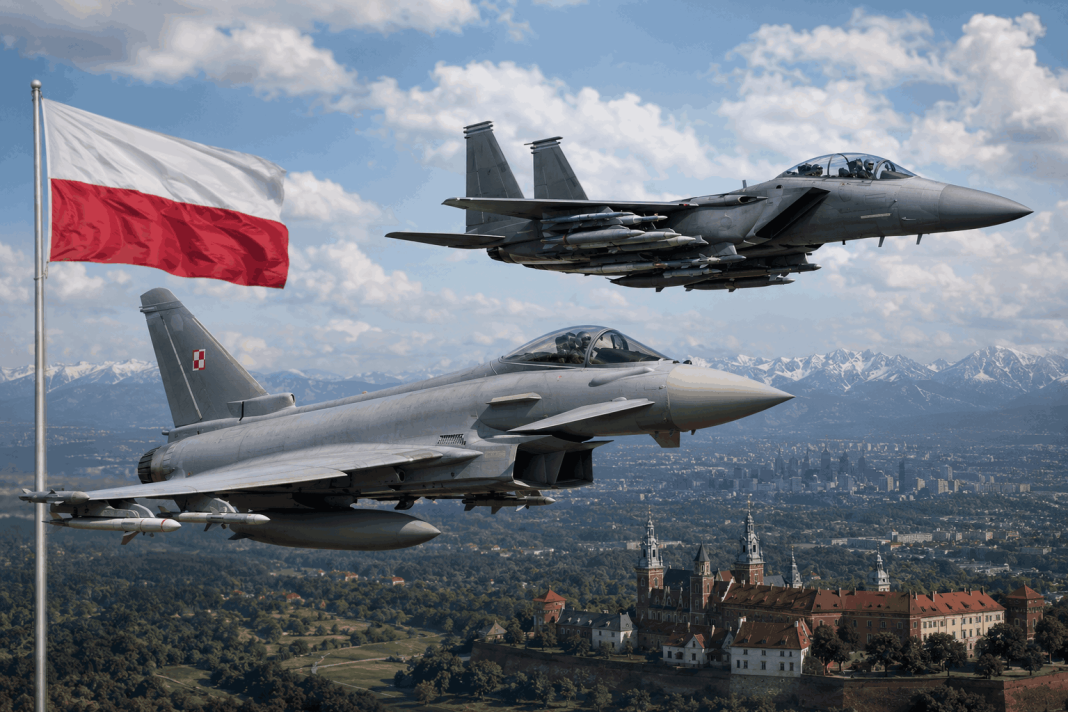
Typhoon Fighter Choice: Poland Weighs Eurofighter Over F-15EX
Poland’s next Typhoon Fighter Choice could reshape its air force for decades. As one of NATO’s most important frontline nations, Poland is searching for a new generation of air superiority fighters to strengthen its defenses. Military planners are carefully comparing the Eurofighter Typhoon and Boeing F-15EX Eagle II, with each aircraft offering different advantages in performance, logistics, and long-term strategy.
Beyond aircraft performance, the decision also reflects Poland’s wider defense priorities, including stronger European cooperation, industrial partnerships, and future military modernization.
Why Typhoon Fighter Choice Matters for Poland
Poland has rapidly expanded its military capabilities over the past several years. The country already has 32 F-35A Lightning II stealth fighters on order while introducing FA-50 light combat aircraft into service. However, officials continue searching for approximately 32 additional fourth-and-a-half-generation fighters to replace the remaining MiG-29 fleet and reinforce national air defense.
Given Poland’s location on NATO’s eastern border, its air force requires fighters capable of rapid interception, long patrol missions, and effective air superiority during high-intensity operations. These new aircraft will complement rather than replace the stealth capabilities of the F-35.
Typhoon Fighter Choice Offers Outstanding Agility
The Eurofighter Typhoon has earned a strong reputation as one of the world’s most agile multirole fighters. Its relatively lightweight airframe gives it exceptional climb rates, rapid acceleration, and excellent maneuverability during air combat.
One of the aircraft’s biggest strengths is its ability to supercruise, allowing sustained supersonic flight without relying on afterburners. This improves fuel efficiency while enabling faster response times during interception missions.
The latest Typhoon variants also feature upgraded AESA radar technology, advanced electronic warfare systems, and compatibility with highly capable European weapons, including the Meteor beyond-visual-range missile. These capabilities make the aircraft particularly effective in modern air superiority missions.
Typhoon Fighter Choice Compared with the F-15EX
The Boeing F-15EX Eagle II remains one of the most capable heavy fighters available today. It offers exceptional payload capacity, impressive range, and the ability to carry large numbers of air-to-air and air-to-ground weapons.
Its powerful AN/APG-82 Active Electronically Scanned Array (AESA) radar provides excellent situational awareness, while its large weapons capacity makes it ideal for strike operations and long-range engagements.
However, the Typhoon focuses on different strengths. Thanks to its lighter design and superior thrust-to-weight ratio, it delivers outstanding agility, quicker acceleration, and excellent performance in close-range aerial combat.
Rather than viewing one aircraft as universally better, defense analysts generally see the Typhoon and F-15EX as serving different operational roles. Poland’s final decision will depend on which strengths best match its future defense strategy.
Typhoon Fighter Choice Supports European Defense
The procurement decision also carries significant political and industrial implications.
Selecting the Eurofighter would strengthen cooperation with major European aerospace companies, including Airbus, BAE Systems, and Leonardo. This could improve supply chain resilience while reducing dependence on overseas manufacturing and maintenance.
European production also offers opportunities for technology transfer, local industrial participation, and workforce development. These benefits align with Poland’s broader objective of expanding its domestic defense industry while maintaining close cooperation with NATO allies.
Furthermore, choosing the Typhoon could position Poland for future participation in next-generation European defense projects such as the Global Combat Air Programme (GCAP).
Typhoon Fighter Choice Strengthens Pilot Training
Another advantage frequently highlighted by defense experts is the Eurofighter’s mature training ecosystem.
Countries already operating the Typhoon have developed advanced simulation systems, comprehensive pilot training programs, and well-established maintenance procedures. Italy, Germany, Spain, and the United Kingdom have accumulated years of operational experience that new operators can leverage.
Modern simulators allow pilots to practice complex missions, radar management, electronic warfare, and air combat scenarios before entering live flight training. This approach helps reduce operational costs while improving readiness.
For Poland, access to an experienced European training network could accelerate pilot conversion and operational capability.
Typhoon Fighter Choice Benefits NATO Operations
Poland already fields a diverse air fleet that includes F-16 Fighting Falcons, FA-50 light fighters, and incoming F-35 stealth aircraft.
Adding the Eurofighter would create a highly flexible force structure. The F-35 would focus on stealth penetration and intelligence gathering, while the Typhoon would perform air superiority, interception, and homeland defense missions.
This combination mirrors the strategy adopted by several NATO members that operate complementary fighter fleets rather than relying on a single aircraft type.
Maintaining multiple capabilities also improves resilience during extended operations and enhances alliance interoperability across Europe.
Typhoon Fighter Choice Will Shape Future Procurement
Although no final procurement decision has been announced, Poland continues evaluating operational performance, delivery schedules, acquisition costs, industrial benefits, and long-term maintenance requirements.
The government must also consider geopolitical factors, alliance relationships, and future defense technology investments before selecting its next fighter platform.
Whether Poland ultimately chooses the Eurofighter Typhoon, the F-15EX, or expands its F-35 fleet, the decision will influence European air power for many years.
For now, defense observers continue watching closely as one of Europe’s largest military modernization programs moves toward its next major milestone.
Final Thoughts on Typhoon Fighter Choice
Poland’s fighter competition represents far more than a simple aircraft purchase. It reflects strategic planning, defense cooperation, industrial growth, and NATO’s evolving security environment.
The Eurofighter Typhoon offers exceptional agility, advanced European technology, and strong opportunities for regional cooperation. Meanwhile, the F-15EX delivers unmatched payload capacity and proven long-range strike capability.
As procurement discussions continue, Poland’s final decision will become one of the most significant European defense acquisitions of the decade, helping define NATO’s air power across its eastern frontier.

Nuwan Wackwella is a digital creator passionate about technology, creativity, and sharing inspiring moments from everyday life.