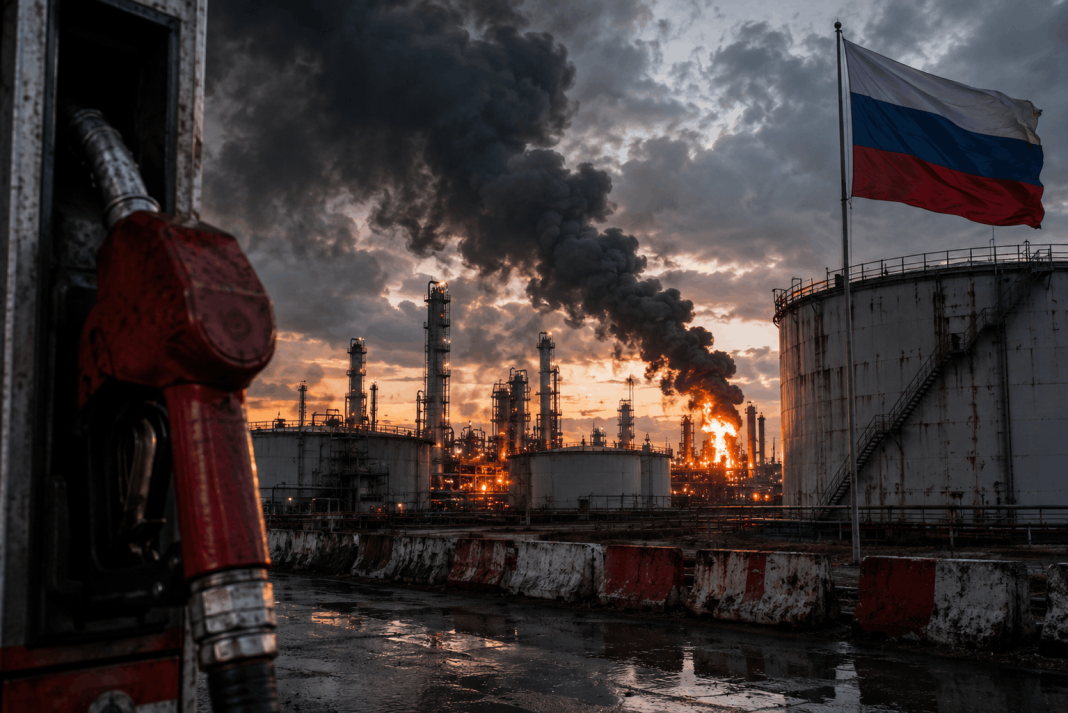
Russia Fuel Crunch Deepens as Oil Output Falls to Lowest Level in a Year
The Russia Fuel Crunch is becoming one of the most significant challenges facing the country’s energy sector in 2026. After months of sustained Ukrainian drone strikes on key oil infrastructure, Russia’s crude production has fallen to its lowest level in a year. The decline is now affecting refinery operations, domestic fuel supplies, exports, and government revenue.
This article examines the causes behind the production slump, the growing pressure on fuel markets, and the wider implications for Russia’s economy and energy industry.
Russia Fuel Crunch Drives Oil Production Lower
Russia’s oil production continued its downward trend in May, marking the sixth consecutive month of declines. Official data showed crude oil and condensate output falling to approximately 9.009 million barrels per day.
That figure represents a significant reduction from production levels recorded earlier in the year. Analysts point to repeated attacks on energy facilities as the primary factor behind the slowdown.
The decline highlights the increasing vulnerability of Russia’s energy infrastructure. While the country remains one of the world’s largest oil producers, maintaining production has become more difficult as critical facilities face repeated disruptions.
Russia Fuel Crunch Linked to Record Drone Attacks
A major reason behind the production decline is the growing intensity of Ukraine’s drone campaign.
During May alone, energy facilities across Russia reportedly experienced more than 30 attacks. These operations targeted refineries, storage terminals, export facilities, and pipelines that play a crucial role in processing and transporting crude oil.
Unlike earlier strikes that focused mainly on storage areas, recent attacks have concentrated on more complex refinery components. These facilities are essential for converting crude oil into gasoline, diesel, aviation fuel, and other refined products.
As a result, the impact on fuel production has been far more severe and long-lasting.
Russia Fuel Crunch Hits Refineries Hardest
Refineries have become the most vulnerable part of Russia’s energy network.
Energy experts note that hydrocrackers and secondary processing units are particularly difficult to repair. These systems use advanced technology and specialized components that are often subject to international sanctions.
When these units are damaged, repairs can take months rather than weeks.
Industry data suggests that offline secondary refining capacity increased substantially during the spring. The loss of these facilities has reduced the country’s ability to transform crude oil into usable fuel products.
Consequently, fuel availability across several regions has tightened considerably.
Russia Fuel Crunch Creates Regional Fuel Shortages
The consequences are increasingly visible at the consumer level.
Authorities have introduced fuel sales restrictions in multiple regions to prevent supply disruptions. Reports indicate that more than a dozen areas have implemented measures aimed at limiting panic buying and preserving inventories.
In some locations, motorists have faced long queues at petrol stations. Occupied Crimea has reportedly experienced some of the most noticeable shortages.
To stabilize supplies, the government expanded restrictions on fuel exports. Gasoline export bans remain in place, while aviation fuel exports have also faced limitations.
These measures underline the seriousness of the situation facing domestic markets.
Russia Fuel Crunch Impacts Refinery Throughput
Refinery throughput has fallen sharply alongside production.
Recent processing volumes dropped to levels not seen since 2009, according to industry estimates. Early June figures suggest that the downward trend may continue if infrastructure disruptions persist.
Lower refining activity creates a complex situation for the government. While reduced processing allows more crude oil to be exported directly, it simultaneously limits the availability of refined fuels needed by households and businesses.
This balancing act has become increasingly difficult as attacks continue to target critical infrastructure.
Russia Fuel Crunch Challenges Energy Supply Chains
Another major issue involves supply chain disruptions.
Repeated strikes have forced operators to delay maintenance schedules, reroute shipments, and temporarily shut down facilities. Some locations have been targeted multiple times within weeks, making recovery efforts even more challenging.
The Tuapse refinery and port complex offers a clear example. After suffering repeated attacks, oil loading activity reportedly declined dramatically compared with the previous year.
Such disruptions not only affect production but also increase transportation costs and operational uncertainty across the energy sector.
Russia Fuel Crunch Threatens Government Revenue
Oil and gas remain the backbone of Russia’s federal budget.
Revenue generated from energy exports helps finance public spending, infrastructure projects, and military operations. Therefore, sustained production declines create direct fiscal pressure.
Even though some export terminals have recovered from earlier disruptions, overall output remains below previous levels. Every reduction in production potentially translates into lower tax receipts and export earnings.
Economists warn that prolonged infrastructure damage could weaken the government’s financial position if current trends continue.
Russia Fuel Crunch Reveals Limits of Adaptation
Since the start of the conflict, Russia has adapted to numerous sanctions and logistical challenges. However, experts argue that refinery bottlenecks present a different problem.
Storage facilities can often be repaired relatively quickly. Secondary processing units, on the other hand, require specialized equipment that is harder to source under sanctions.
This means that successful attacks on critical refinery systems can produce lasting effects that are difficult to offset through alternative measures.
As the frequency and precision of drone operations increase, maintaining operational resilience becomes increasingly difficult.
Russia Fuel Crunch Signals a Larger Strategic Shift
The broader significance extends beyond fuel supplies.
Ukraine’s strategy increasingly focuses on targeting economic assets that support Russia’s war effort. Energy infrastructure has become a central component of that campaign.
Record numbers of attacks during recent months demonstrate a shift toward long-range operations capable of reaching deep inside Russian territory.
The result is growing pressure on one of the country’s most valuable industries.
While Russia continues to export substantial amounts of oil, the cumulative effect of repeated strikes is becoming more apparent with each passing month.
Conclusion
The Russia Fuel Crunch is no longer a temporary disruption. Falling oil production, damaged refinery infrastructure, regional fuel shortages, and declining refining capacity all point to mounting pressure on Russia’s energy sector.
Although some export operations remain resilient, the continuing decline in production highlights the effectiveness of attacks targeting critical bottlenecks within the oil industry.
As sanctions remain in place and drone strikes continue, the challenges facing Russia’s energy network are likely to persist. The coming months will reveal whether repair efforts can keep pace with ongoing disruptions or whether the Russia Fuel Crunch will deepen further, affecting not only fuel supplies but also government finances and long-term economic stability.

Nuwan Wackwella is a digital creator passionate about technology, creativity, and sharing inspiring moments from everyday life.