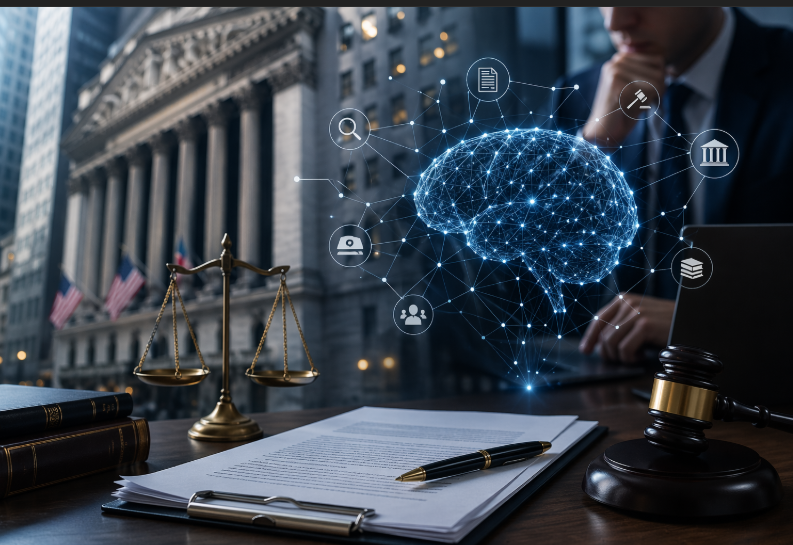
The recent AI Hallucinations Legal issue uncovered in a high-profile Wall Street law firm filing has raised serious concerns across both the legal and technology sectors. The incident revealed how artificial intelligence can generate false information that appears credible, leading to significant risks in professional environments. In industries like law, where precision and accuracy are essential, even minor errors can lead to major consequences.
This situation goes beyond a single firm’s mistake. It highlights a growing challenge as more professionals rely on AI tools for critical tasks. While AI offers efficiency and speed, the AI Hallucinations Legal problem demonstrates that unchecked automation can undermine trust and reliability.
AI Hallucinations Legal Issue in the Filing
The controversy began when legal experts reviewed the filing and discovered inconsistencies. Several citations included in the document did not exist, raising immediate red flags. These errors were traced back to AI-generated content.
The AI Hallucinations Legal problem became evident when fake case laws and inaccurate references were identified. Such errors not only weaken legal arguments but also risk damaging the credibility of the law firm involved. In legal proceedings, every citation must be verifiable, and any deviation can have serious implications.
As a result, the firm had to act quickly to correct the filing and provide explanations. The incident quickly gained attention, sparking discussions among legal professionals and AI experts about the reliability of automated systems.
Explore AI ethics guidelines.
Why AI Hallucinations Legal Errors Matter
The concept of AI hallucinations refers to situations where AI systems produce information that sounds accurate but is actually false. This becomes especially dangerous in law, where facts must be precise and thoroughly validated.
The AI Hallucinations Legal issue highlights how easily misinformation can enter official documents. When legal professionals rely heavily on AI without verification, they risk introducing false data into critical filings.
Beyond technical errors, these mistakes can erode trust. Clients depend on lawyers for accurate and reliable advice. If AI tools compromise that reliability, the professional relationship may suffer. This makes addressing the AI Hallucinations Legal challenge a top priority for the industry.
AI Hallucinations Legal Impact on Modern Law Firms
Many law firms today use AI tools to improve efficiency. These technologies assist with research, drafting documents, and organizing case information. The benefits are clear faster workflows and reduced workload for legal teams.
However, the AI Hallucinations Legal incident shows the limitations of such tools. While AI can process vast amounts of data quickly, it lacks the ability to verify truth in the way humans do. Without proper oversight, errors can go unnoticed.
This has led experts to emphasize the importance of training. Lawyers must understand how AI systems function, including their weaknesses. Only then can they effectively manage risks associated with the AI Hallucinations Legal problem.
Risks Highlighted by AI Hallucinations Legal Case
The incident has brought attention to several risks facing the legal industry. First, there is the issue of professional responsibility. Lawyers are required to ensure the accuracy of all submitted documents, regardless of whether AI tools are used.
The AI Hallucinations Legal case may lead to stricter regulations. Courts could require disclosures when AI is used in legal filings, ensuring transparency and accountability. Firms that fail to meet these standards may face penalties or reputational damage.
Reputation is particularly important in competitive environments like Wall Street. A single high-profile mistake linked to AI Hallucinations Legal errors can impact client confidence and long-term business relationships.
Learn about responsible AI use: AI Risk Management Framework
Need for Oversight in AI Hallucinations Legal Use
Experts are now calling for stronger oversight mechanisms. One key recommendation is mandatory human review of all AI-generated content before submission. This simple step can significantly reduce the risk of errors.
The AI Hallucinations Legal issue has also sparked discussions about industry-wide guidelines. Regulatory bodies may introduce frameworks to govern how AI is used in legal practice, ensuring consistent standards across firms.
Additionally, internal policies within organizations can play a crucial role. Law firms should establish clear protocols for AI usage, including verification procedures and accountability measures to prevent future AI Hallucinations Legal incidents.
Brexit Legal Risks: Navigating Customs and Supply Chains
Lessons from AI Hallucinations Legal Incident
This case offers valuable lessons for professionals adopting AI tools. First, it reinforces that AI is not infallible. While it can generate convincing content, it does not guarantee accuracy.
The AI Hallucinations Legal situation serves as a reminder that human judgment remains essential. Technology should enhance professional work, not replace critical thinking and verification.
Furthermore, it highlights the importance of continuous learning. As AI evolves, professionals must stay informed about its capabilities and limitations. This awareness can help prevent similar AI Hallucinations Legal issues in the future.
Future of AI Hallucinations Legal Challenges
Looking ahead, AI will continue to play a major role in the legal industry. Its ability to streamline processes and improve efficiency makes it an attractive tool for firms worldwide.
However, the AI Hallucinations Legal challenge must be addressed to ensure safe adoption. Developers are already working on improving AI accuracy and transparency, aiming to reduce the likelihood of hallucinations.
The future will likely involve a balanced approach, where AI tools are combined with strong human oversight. By doing so, the legal industry can harness the benefits of technology while minimizing risks associated with AI Hallucinations Legal errors.
Conclusion: Managing AI Hallucinations Legal Risks
The Wall Street filing incident has become a critical example of the risks posed by AI in professional settings. It demonstrates that while AI offers significant advantages, it must be used responsibly.
Addressing the AI Hallucinations Legal problem requires a combination of better tools, stricter oversight, and increased awareness. Law firms must prioritize accuracy and accountability to maintain trust and credibility.

I’m an Online Media & PR Strategist at BusinessFits, passionate about digital storytelling and media impact. As a journalist, blogger, and SEO specialist, I create content that connects, informs, and ranks.