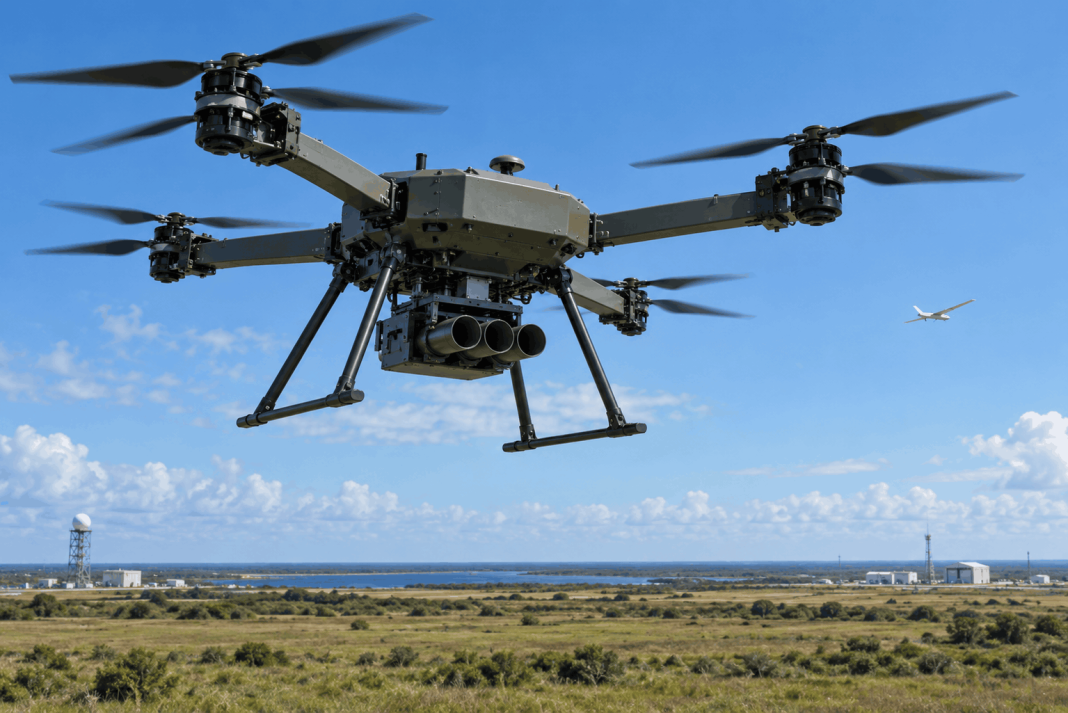
Drone Defence Trials Advance TRV-150 Counter-Drone Capability
A cargo drone has demonstrated a new role: intercepting other drones. Recent Drone Defence Trials saw the modified TRV-150 engage several aerial targets during one flight. The aircraft fired successive laser-guided rockets without landing or reloading, according to BAE Systems.
The company announced the results on 21 October 2026, following experiments at Eglin Air Force Base in Florida. Its Maryland-based partner, SURVICE Engineering, supported the demonstration. The aircraft carried a three-pod launcher equipped with Advanced Precision Kill Weapon System, or APKWS, rockets.
The result extends an earlier single-shot demonstration and strengthens the case for adapting logistics aircraft to defensive missions. However, a successful experiment does not establish that an armed system has entered operational service. baesystems.com
For military buyers, the wider question concerns value. Can reusable aircraft help address aerial threats while keeping equipment, staffing and support costs manageable?
How Drone Defence Trials Build on Earlier Tests
The latest announcement follows earlier work on combining the TRV-150 with precision rockets. These experiments tested whether a platform designed for supplies could also carry and launch weapons.
A US Army report on the May 2026 launcher tests described a three-shot configuration at Fort Rucker. Engineers examined flight-control performance and the aircraft’s physical response during firing.
The work included checking how the drone compensated for launch forces from the launcher’s outer tubes. This matters because carrying a payload and releasing it create different demands on an aircraft.
SURVICE said the project began as internally funded research and development in January 2025. The Army report also identified further experimentation involving base defence, air defence and counter-drone missions. The United States Army
Earlier proof-of-concept work at Dugway Proving Ground involved both airborne and ground targets. The Army identified contributions from BAE Systems, SURVICE Engineering, Invariant Corporation and other partners.
That account described the TRV-150 as a modified Malloy T-150 adapted for US Marine Corps logistics requirements. It reported three successful target engagements during that earlier test programme. Those results provide background, rather than a performance score for the latest Florida experiment. army.mil
Taken together, the announcements show a development sequence. First came proof that the combination could work. Later experiments examined a launcher carrying multiple rounds and a broader defensive role.
Readers can explore the wider context through your [uncrewed aircraft technology guide — insert internal article URL].
Why Drone Defence Trials Put Affordability in Focus
The commercial appeal rests on a straightforward idea: adapt available equipment instead of developing every component from scratch.
However, affordability requires more than comparing the price of one rocket with another weapon. Buyers must consider the aircraft, communications equipment, maintenance, training and supporting personnel.
They also need to assess availability. A lower purchase price offers limited value if equipment needs frequent repairs or extensive support.
For this reason, the latest demonstration raises useful questions without answering every financial one. The announcement does not provide a complete operating-cost comparison or a cost for each successful interception.
Claims that the system will deliver guaranteed savings would therefore go beyond the published evidence. A stronger conclusion is that the partners have demonstrated an approach intended to improve affordability.
Multiple engagements during one flight could also influence how buyers assess productivity. Returning to land interrupts a mission and requires another preparation cycle before the aircraft can fly again.
Nevertheless, carrying several rounds does not establish how long a system can sustain operations. Battery use, maintenance needs and crew workload would all affect practical availability.
These are procurement considerations, rather than results established by the trial announcement. They help explain why demonstrations usually form one part of a longer evaluation process.
For related coverage, add an internal link to your [defence innovation and technology investment article — insert internal article URL].
What Drone Defence Trials Reveal About Platform Versatility
Another important feature is the aircraft’s origin. The TRV-150 comes from a logistics platform, giving the project a different starting point from a purpose-built interceptor.
BAE Systems says SURVICE adapted the version used in the latest trials for US Army requirements. Its FalconWorks division developed and integrated the APKWS modification kit.
The company also reports that the T-150 has delivered supplies for British forces. Its logistics work included moving cargo between Royal Navy ships during the Carrier Strike Group’s 2025 Indo-Pacific deployment. Further details appear in the official BAE Systems announcement. baesystems.com
For buyers, a platform with several possible roles can create opportunities. Shared training, maintenance knowledge and support arrangements may offer benefits across different missions.
However, those benefits need evidence. A logistics configuration and an armed configuration may impose different requirements for testing, certification and personnel.
Organisations must also consider competing priorities. An aircraft assigned to defensive duties cannot simultaneously complete a separate supply mission.
Consequently, versatility should support a clear purchasing decision. Buyers need to understand which role matters most, how often equipment will change roles and what each configuration requires.
The broader business lesson is practical. Reusing an established platform can shorten some development steps, but integration still needs careful evaluation.
What Comes After Drone Defence Trials at Sea
The partners now intend to explore maritime counter-drone applications, according to BAE Systems. This remains a development objective rather than confirmation of an operational naval weapon. baesystems.com
Shipboard logistics experience provides relevant background, but it does not automatically validate an armed maritime role. Each mission brings its own operating demands and approval requirements.
Future announcements will be more informative if they explain what evaluators tested and which conditions applied. Buyers will also want clarity about reliability, support arrangements and delivery schedules.
Likewise, describing a launcher as production-ready does not confirm a procurement contract. The distinction matters for readers assessing the project’s commercial significance.
For now, the clearest achievement is the reported engagement of successive aerial targets during a single flight. That moves the programme beyond its earlier single-shot demonstrations.
The next challenge is turning experimental success into a dependable capability that customers can evaluate, purchase and support. Further testing and transparent performance reporting will determine how far this promising approach progresses.

I’m an Online Media & PR Strategist at BusinessFits, passionate about digital storytelling and media impact. As a journalist, blogger, and SEO specialist, I create content that connects, informs, and ranks.