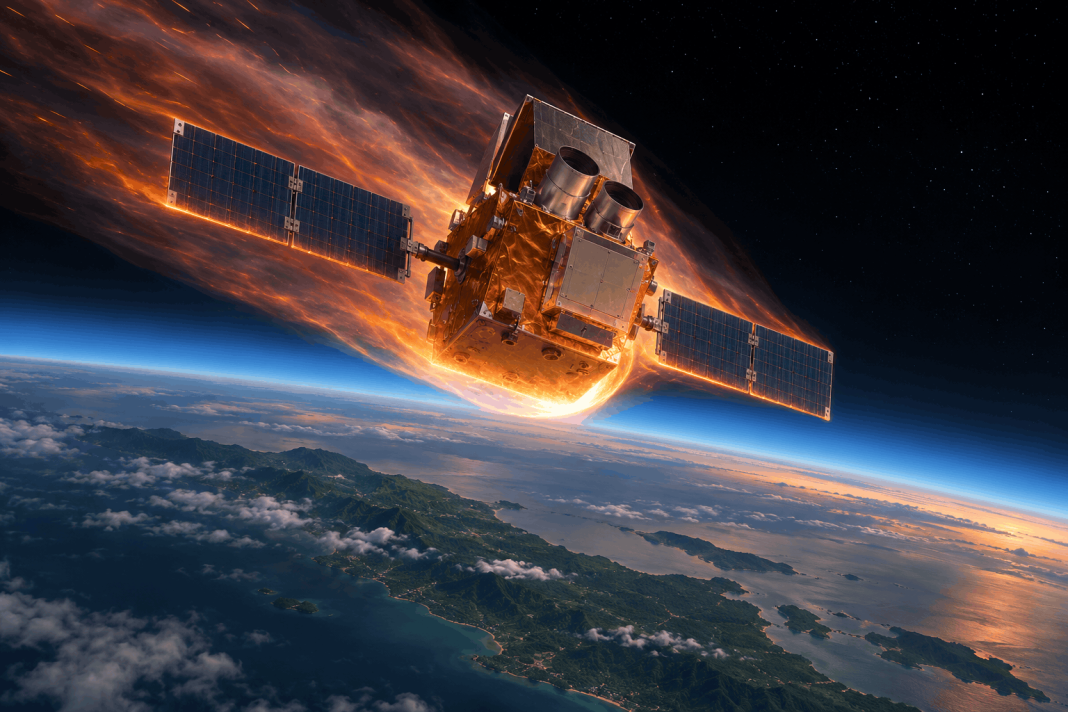
NASA’s Swift Space Telescope Ends Its Mission in Fiery Re-entry
NASA’s Swift space telescope re-entered Earth’s atmosphere over North Sumatra, Indonesia, on 4 November 2026. The fiery descent ended nearly 22 years in orbit for an observatory built for a two-year prime mission. For more than two decades, it raced to capture some of the most powerful explosions in the universe. Its final plunge came less than three months after engineers called off an attempt to raise its orbit.
Where the Swift Space Telescope Re-entered
The U.S. Space Force confirmed that Swift re-entered at 12:39 UTC, or 7:39 p.m. local time in North Sumatra. The spacecraft weighed about 1,450 kilograms. Before the descent, NASA expected most of it to burn up high in the atmosphere. However, it also expected some denser components to survive. Read NASA’s re-entry tracking update.
The reported location marks where Swift entered the atmosphere. Any fragments that survived could have travelled farther along its path before reaching the surface. Before re-entry, officials estimated the chance of anyone on Earth coming to harm at about 1 in 2,100. NASA had reported no injuries or damage from falling debris as of 4 November. Read NASA’s pre-entry assessment.
Why the Swift Space Telescope Lost Altitude
Even hundreds of kilometres above Earth, satellites in low orbit pass through traces of air. As a spacecraft moves through that thin gas, it loses a small amount of orbital energy. Over time, its orbit sinks. At lower altitudes, it encounters denser air, which increases drag and can speed up the descent.
In Swift’s final years, strong solar activity heated and expanded the upper atmosphere. That raised the density of the air at Swift’s altitude. The observatory had no propulsion system to lift itself back to a higher orbit. Its controllers could still point it in ways that reduced drag, buying time for a rescue mission.
After engineers shelved the boost attempt, Swift resumed observations for a final stretch. It turned its instruments towards hundreds of targets, from comets in our solar system to distant galaxies. On 20 October, at about 275 kilometres above Earth, the spacecraft entered safe mode. The operations team then sent the command that ended its science mission. Read the account of Swift’s final observations.
Why the Swift Space Telescope Rescue Fell Short
NASA hired Katalyst Space to build LINK, a robotic spacecraft that launched in July 2026. The plan called for LINK to approach Swift, grip it with robotic arms and lift it into a higher orbit. That extra altitude would have given the observatory more time to study the changing sky.
LINK had trouble controlling its orientation after launch and began to spin. A software update restored pointing control, but the team dropped the planned orbit boost in August. LINK still tested its propulsion system and robotic arms. It even photographed Swift during a pass roughly 12 to 15 kilometres away. The two spacecraft never docked. Read NASA’s review of the boost mission.
How the Swift Space Telescope Caught Cosmic Explosions
Swift launched in November 2004 to investigate gamma-ray bursts, sudden flashes of high-energy light from deep space. Some last less than two seconds. By the time another telescope learns where to look, the brightest flash can already be over. The fading light that follows, called an afterglow, gives astronomers a second chance to study the event.
One instrument detected each burst and worked out where it came from. The spacecraft then turned so its X-ray and ultraviolet and optical telescopes could search for the afterglow. Swift could often do this in about a minute. It also sent alerts to other observatories, giving astronomers on the ground a chance to follow the same event.
The alert was especially valuable because the instruments on Swift and the ground could measure different kinds of light. X-rays can reveal an afterglow even when it is faint at visible wavelengths. A ground telescope can then study the host galaxy or collect other measurements as the light fades. The earlier those observations begin, the more of the event astronomers can piece together.
What the Swift Space Telescope Discovered
One breakthrough came in May 2005. A gamma-ray burst lasted just 0.03 seconds, yet Swift turned quickly enough to catch its fading X-rays. It was the first time astronomers detected the afterglow of a short gamma-ray burst. The observation helped support the idea that some short bursts come from two neutron stars merging.
Swift went on to observe more than 2,000 gamma-ray bursts and study over 1,400 supernovae. It also watched black holes tear apart stars and tracked comets closer to Earth. Over its lifetime, data from the observatory contributed to about 7,000 scientific papers. Explore Swift’s science highlights.
What the Swift Space Telescope Leaves Behind
Swift’s public archive contains nearly 22 years of measurements and more than 1.5 million ultraviolet and optical images. Astronomers can use those records to check whether a newly active object has flared before. They can also compare events across different wavelengths to see how an explosion changed as it faded. Explore how researchers use computing to study data from space.
The mission also showed how much astronomers gain when observatories act together. A single observatory can only see part of a fast-moving event, especially when weather or daylight limits views from the ground. An alert from orbit could prompt a telescope on Earth to start taking measurements while an afterglow was still bright. With Swift gone, NASA is exploring how existing missions can respond to those fast-moving events. The archive gives researchers a record of what earlier outbursts looked like and a way to compare them with the next ones.

Nuwan Wackwella is a digital creator passionate about technology, creativity, and sharing inspiring moments from everyday life.