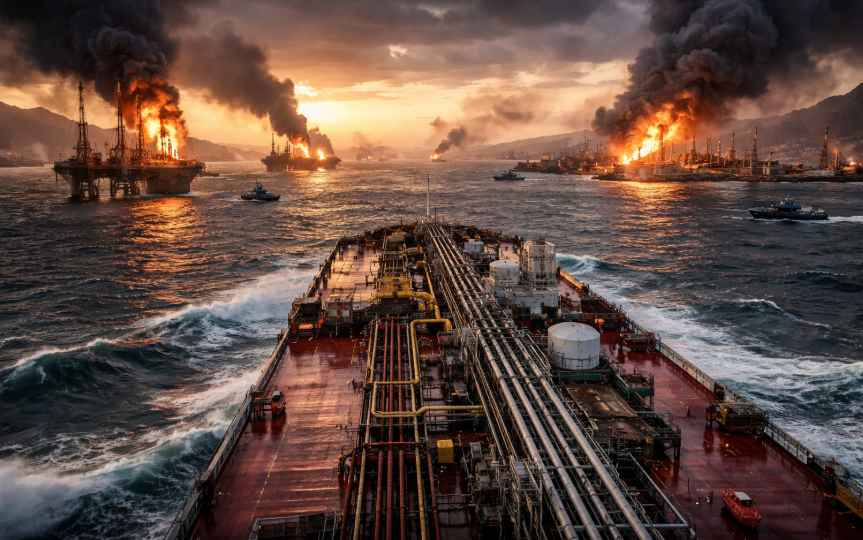
The moment oil prices hit $100 per barrel, global markets immediately felt the shock. Fuel costs surged, investors grew anxious, and governments began planning emergency responses. The sudden price jump followed a rapidly escalating conflict between the United States, Israel, and Iran that began on February 28, 2026. As the conflict intensified, a major energy chokepoint the Strait of Hormuz became unsafe for shipping, triggering fears of a major supply disruption.
Brent crude quickly surged past $110 per barrel, while West Texas Intermediate climbed above $105. With about one-fifth of the world’s oil transported through the Strait of Hormuz, even partial disruption can push global energy markets into chaos. The speed at which markets reacted shows how sensitive the global economy remains to geopolitical tensions in the Middle East.
Oil Prices Hit Global Supply Chains After Strait Closure
When oil prices hit the $100 mark, the biggest driver was the sudden disruption of oil transport routes. Tankers began avoiding the Strait of Hormuz due to rising military threats and missile attacks in the region.
This narrow waterway connects Persian Gulf oil producers to international markets. Countries like Saudi Arabia, Iraq, Kuwait, and the United Arab Emirates depend heavily on it to export crude. With shipping insurers raising costs and vessels refusing to enter the area, oil shipments slowed dramatically.
Meanwhile, Iran reported strikes on energy infrastructure including fuel depots and power grids. Missile exchanges and drone attacks increased concerns that the conflict could expand across the region. Iran also announced a new political leadership change during the crisis, signaling that the confrontation may last longer than initially expected.
Supply disruptions in the Middle East often trigger immediate price spikes because global oil inventories remain tightly balanced. Even rumors of blockades or sanctions can push prices upward.
Oil Prices Hit Consumers Through Rising Fuel Costs
Once oil prices hit triple digits, consumers worldwide quickly felt the consequences. Gasoline prices in the United States jumped to about $3.45 per gallon an increase of roughly 16% since the conflict began. Diesel prices climbed even faster due to global shipping demand.
Europe and Asia faced even greater pressure. These regions rely heavily on imported energy from the Middle East, meaning disruptions translate directly into higher electricity and transportation costs.
For households, rising energy prices mean higher bills for fuel, heating, and electricity. Businesses, especially logistics companies and airlines, often pass these costs to customers. That leads to rising prices across multiple sectors from groceries to airline tickets.
Energy economists warn that sustained price spikes could trigger broader inflation. Some analysts estimate inflation could climb toward 4.5% globally if oil prices remain elevated for several months.
Oil Prices Hit Financial Markets and Investor Confidence
When oil prices hit $100, stock markets across Asia and the United States quickly responded with sharp declines. Asian stock indices dropped between 4% and 6%, while U.S. futures for the S&P 500 slid nearly 1.7%.
Investors fear a combination of rising inflation and slowing economic growth a scenario often called stagflation. During such periods, economic activity weakens while living costs rise.
Government bond markets also reacted. Yields on the U.S. 10-year Treasury turned positive for the year as investors demanded higher returns amid uncertainty. Several European and Asian government bonds reached multi-year yield highs.
The U.S. dollar strengthened as investors sought safe-haven assets. Traditionally, gold also benefits during crises, but a strong dollar limited gains in precious metals.
Financial analysts say markets remain in a “fear phase,” where investors closely monitor geopolitical developments and diplomatic signals.
Oil Prices Hit Energy Security Strategies Worldwide
As oil prices hit $100, governments began evaluating emergency strategies to stabilize supply. The Group of Seven (G7) nations discussed the possibility of releasing oil from strategic reserves to calm markets.
The United States also offered insurance support for tankers traveling near conflict zones to keep energy flowing. At the same time, sanctions adjustments allowed countries like India to continue purchasing Russian oil, helping prevent further shortages.
Energy officials argue that global supply levels remain sufficient in the short term. However, shipping disruptions could still create temporary shortages in some regions.
According to energy analysts at International Energy Agency, strategic reserves can offset short-term disruptions but cannot replace long-term supply losses. Meanwhile, the U.S. Energy Information Administration warns that prolonged conflicts could push prices significantly higher.
For deeper analysis on energy markets, see our internal guide: Centrica Profit Decline: Energy Giant Faces 40% Earnings Drop
Oil Prices Hit $120? Expert Forecasts and Market Outlook
Analysts now debate how high prices could climb after oil prices hit $100. Some banks predict Brent crude could approach $120 per barrel if the Strait of Hormuz remains unsafe for extended periods.
Barclays and other financial institutions warn that supply disruptions combined with strong global demand could tighten markets quickly. Emerging economies may suffer the most because they rely heavily on imported energy and have weaker currencies.
At the same time, governments hope diplomatic pressure could bring a ceasefire. If shipping routes reopen and tensions ease, oil prices could fall rapidly.
Historical energy crises show similar patterns. The 1956 Suez Crisis disrupted oil shipments but involved far smaller portions of global supply. Today, with around 20% of global oil trade moving through one chokepoint, the potential impact is far greater.
Oil Prices Hit a Turning Point for the Global Economy
The moment oil prices hit $100 per barrel may mark a significant turning point for the global economy. Energy markets are once again reminding the world how vulnerable they are to geopolitical conflict.
Drivers may need to prepare for higher fuel costs, while investors increasingly shift toward safer assets. Governments, meanwhile, must balance energy security with diplomatic strategies aimed at reducing conflict.
If tensions escalate further, supply shortages could keep oil markets volatile for months. However, a rapid de escalation or ceasefire could restore shipping routes and bring prices down quickly.
For now, the world watches closely as markets, governments, and consumers adapt to one of the most significant energy shocks in recent years.