Mars Sulfur Discovery: What One Cracked Rock Reveals on Mars
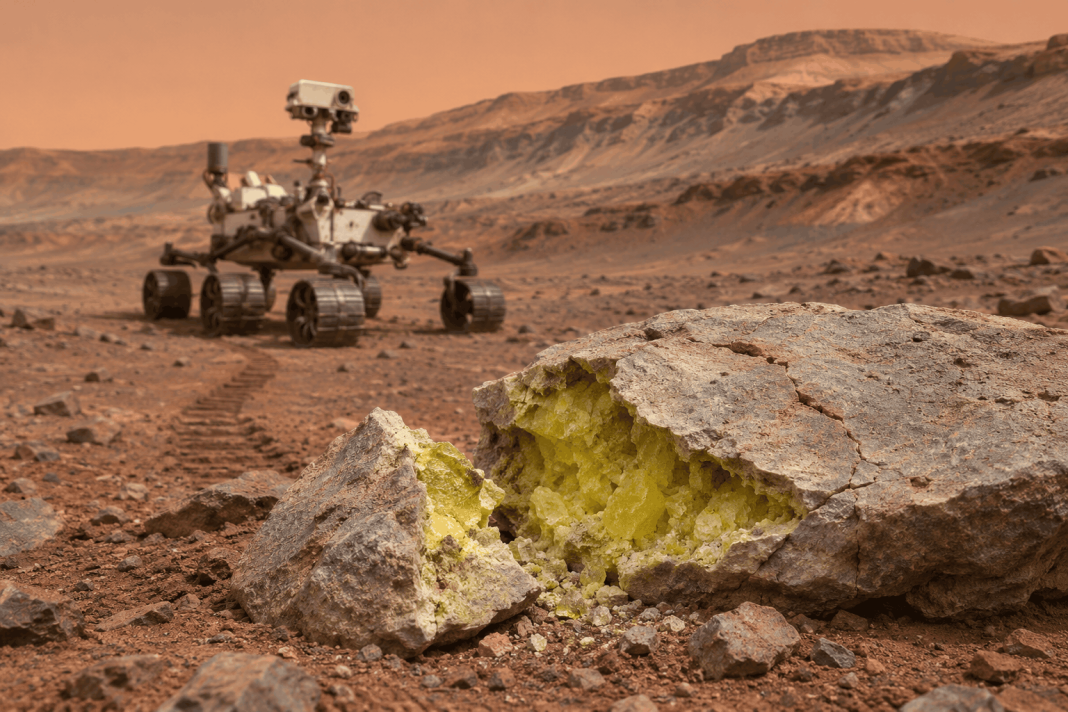
The Mars sulfur discovery began when NASA’s Curiosity rover drove over an ordinary-looking rock and cracked it open. Inside, bright yellow crystals caught the team’s attention. Later, tests showed that the crystals were elemental sulfur, the first confirmed find of this mineral in its pure form on the Red Planet. The broken rock led scientists to examine a field of similar stones and ask how so much sulfur gathered in one place.
How a Cracked Rock Began the Mars Sulfur Discovery
On May 30, 2024, Curiosity was crossing Gediz Vallis, a channel on the slopes of Mount Sharp. The mountain rises from the floor of Gale Crater, where the rover has been studying layers of ancient rock. When one wheel rolled over a pale stone, the rock broke apart. As a result, the rover exposed crystals beneath the weathered surface.
A few days later, Curiosity photographed the fragments, which the team nicknamed Convict Lake. Together, the pieces measured about 13 centimetres across. Before the rock cracked, its pale exterior could easily blend in with the surrounding stones. See the rover’s close-up of the yellow crystals.
At first, the colour gave the team a clue. Then Curiosity used instruments that measure the elements in rocks to check what the crystals contained. The results showed that the stones consisted of native sulfur, the term geologists use for sulfur found in its elemental form.
Why the Mars Sulfur Discovery Surprised Scientists
Scientists already knew that Mars contained sulfur. For example, researchers had found it in minerals called sulfates, where sulfur bonds with oxygen. Some sulfates also contain water in their crystal structure. By contrast, elemental sulfur gave researchers a new clue about the chemical conditions in the channel.
As it turned out, the broken rock was part of a much larger field. Researchers mapped bright stones across an area of roughly 2,100 square metres. Many were only about the size of a hand, and their fragile structure offered a clue about where they formed. If the stones had travelled far through the rocky channel, many would likely have crumbled along the way.
For that reason, the team thinks the stones formed where Curiosity found them or moved only a short distance. The terrain supports that idea. The stones clustered in a low area along the canyon floor, where erosion had cut into older debris. The field’s location helped scientists narrow the list of possible explanations. Explore the mission’s analysis of the sulfur field.
How Ancient Gas Could Explain the Mars Sulfur Discovery
On Earth, elemental sulfur can collect around volcanic vents and hot springs. However, the rocks around the field show little evidence of intense heat close to where the crystals formed. So the researchers asked a question. Could sulfur have come from a hot source elsewhere and gathered in a much colder place?
According to one study, sulfur-rich vapour from magma may have risen and cooled beneath the Martian surface. As the vapour cooled, ice-like structures may have trapped some of the gas underground. These structures, called clathrates, can hold gas molecules within cages formed by water molecules. In this way, the ice could store sulfur-rich gas before it reached the surface.
Later, erosion may have stripped away enough rock to reduce the pressure below. As a result, the trapped gas could have escaped. Then chemical reactions could have produced elemental sulfur at relatively low temperatures. The sequence would explain why the stones sit in an eroded channel without clear signs of intense local heating. Read the study on the deposit’s proposed origin.
What the Mars Sulfur Discovery Reveals About Ancient Mars
The sulfur field offers another clue to the history of the canyon. First, debris collected in the area. Later, erosion cut deeper into the valley floor. The crystals may record what happened below ground as the surface changed. Their position gives scientists a way to connect the shape of the canyon with changes in the chemistry beneath it.
Beyond the canyon itself, the find raises questions about how sulfur moved around ancient Mars. Sulfur can occur in several forms, and each form tells scientists something about the conditions that produced it. Researchers can compare the yellow stones with nearby sulfate minerals to ask where sulfur came from, how it travelled and what allowed it to collect in the channel.
In addition, sulfur matters to the search for environments that could have supported life. For example, some microbes on Earth get energy from reactions involving sulfur compounds. However, geologic processes can also produce elemental sulfur. The crystals alone cannot establish whether organisms ever lived there. For now, the field gives scientists a place to study how gases and minerals interacted beneath an ancient Martian landscape.
What Comes After the Mars Sulfur Discovery
Next, scientists can revisit Curiosity’s images and chemical data to see how the stones vary across the field. They can also compare the deposit with other sites the rover has crossed. If similar stones turn up elsewhere, their surroundings could help show whether the same conditions existed in other parts of Gale Crater.
For readers interested in other ways technology works in space, explore the NeticSpace blog or read about orbital data centres and the challenge of computing in space.
What began as a wheel rolling over a brittle stone has become a question about an entire canyon. The Mars sulfur discovery shows how much of the planet’s history can hide beneath a weathered surface. Now the yellow crystals are easy to see. However, the sequence of events that put them there remains a mystery.

Nuwan Wackwella is a digital creator passionate about technology, creativity, and sharing inspiring moments from everyday life.