Fatal Kent Train Crash Prompts Level Crossing Safety Review
A level crossing safety report has called for changes after a passenger train struck a delivery van and killed its driver near Teynham in Kent. Investigators found that a green light at Bax crossing almost certainly led the driver to enter while the exit gate was still shut. The report, published on 9 November 2026, makes four recommendations covering crossing design, rules for road users and guidance for organisations that rely on people driving for work. Read the full investigation findings.
Level Crossing Safety at Bax Before the Crash
The collision happened shortly before 12:45 pm on 13 July 2025. A passenger service from Ramsgate to London Victoria hit the stationary van at about 71 mph. The train driver applied the emergency brake after seeing the van, but the train could not stop in time. Three passengers reported minor injuries.
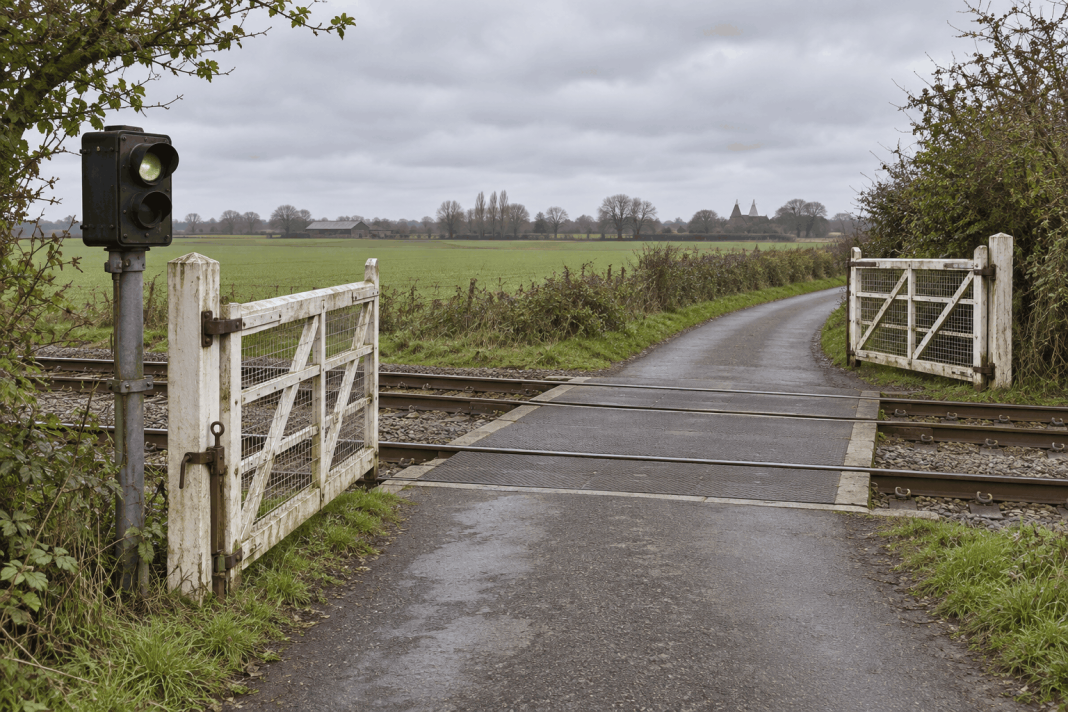
Bax is a private crossing with a gate on each side of the railway. People using the crossing must open and close the gates themselves. Both gates swing away from the tracks, and small lights show whether the system has detected an approaching train. When it detects one, the light turns red and an audible warning sounds.
The signs at Bax told drivers to check for a green light before opening both gates. Drivers then had to check the light again before taking a vehicle across the tracks. Once clear of the railway, they had to check it once more before closing the gates. Opening both gates first gives a vehicle a clear way out and avoids a stop on the tracks.
How the Green Light Affected Level Crossing Safety
The light was green when the delivery driver arrived. He opened the entry gate and drove onto the crossing while the gate on the far side remained closed. Investigators concluded that the green light almost certainly led him to believe he could drive through once the first gate was open. The van was still on the crossing when the warning changed.
The driver tried to open the exit gate. His first attempt left too little room for the van to pass, so he went back to move the gate again. He was returning to the van when the train came into view. By then, the train driver had only a short distance in which to react.
Investigators also found that the signs and the lack of road markings failed to guide the driver through the steps. A green light is a familiar signal to proceed on ordinary roads. At Bax, it also had to be read alongside instructions about gates that road users controlled themselves. The report found that an earlier project to redesign signs had given too little thought to how drivers would interpret these cues together.
Level Crossing Safety Gaps in Design and Driver Training
The report found that Network Rail was unlikely to make further upgrades at crossings once it had fitted miniature stop lights. That left the signs doing much of the work. Drivers still had to spot the instructions, understand the order of the steps and apply them before moving their vehicles. A courier arriving at an unfamiliar address might be seeing that type of crossing for the first time.
The driver was self-employed and delivering parcels on behalf of a logistics company. Investigators found that the training and guidance he received had left him unprepared to use the crossing safely. For delivery firms, the case raises a route-planning question. If an address can only be reached via a private railway crossing, how will the driver learn what to expect before reaching the gate? Read the guidance on managing risks for people who drive for work.
Other collisions show why investigators are looking beyond Bax. In 2017, a train struck a parcel van at nearby Frognal Farm, seriously injuring its driver. That crossing used powered gates and a telephone, so drivers faced a different set of instructions. In August 2026, another delivery driver died at a manual crossing in Lancashire. That case is the subject of a separate investigation. See the Lancashire investigation notice.
Four Level Crossing Safety Recommendations After Bax
The first recommendation asks Network Rail to review how crossings operated by road users are designed and how that design could reduce risk. The second asks the Department for Transport to update the legal framework and guidance for road users. The department would consult the rail regulator and industry bodies in Great Britain as part of that work.
The third recommendation asks the Health and Safety Executive to review its guidance for organisations whose workers drive or ride for work. It covers organisations that employ drivers directly as well as those that engage self-employed workers. The review would focus on how those organisations prepare people to use crossings that they must operate themselves.
The fourth asks Network Rail to clarify how its staff should treat authorised users when assessing crossing risks. Investigators found that staff could interpret the term differently. They raised it as a separate issue from the circumstances of the Bax crash. Clearer guidance would give staff a more consistent way to decide whose journeys to consider when reviewing a crossing.
The four recommendations span the decisions made before a driver ever arrives at the railway. They cover what the crossing tells a first-time user, what rules govern its use and what a delivery company explains before sending someone on the route. At Bax, those decisions came together in a few moments between the entry gate and the railway.

Nuwan Wackwella is a digital creator passionate about technology, creativity, and sharing inspiring moments from everyday life.