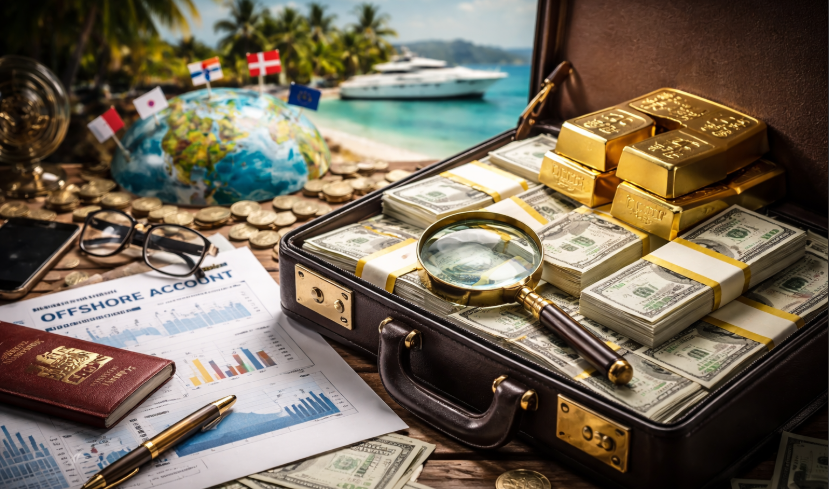
The issue of Hidden Offshore Wealth is growing at an alarming rate, with a new report from Oxfam revealing that the world’s richest individuals may have concealed up to $3.55 trillion from tax authorities. This staggering figure highlights a widening gap between ordinary taxpayers and the ultra wealthy, raising urgent questions about fairness, governance, and global inequality.
While everyday citizens continue to pay taxes on income and consumption, vast sums of money are quietly stored in offshore accounts, beyond the reach of national tax systems. This hidden wealth could otherwise fund essential public services such as healthcare, education, and infrastructure worldwide.
Hidden Offshore Wealth масшle: Global Figures and Trends
According to Oxfam, total offshore wealth reached approximately $13.25 trillion by 2023. Out of this, an estimated $3.55 trillion remains completely unreported to tax authorities. This level of Hidden Offshore Wealth represents more than 3% of global GDP—an enormous economic blind spot.
Research by economists such as Gabriel Zucman shows that despite international reforms, offshore wealth has continued to grow steadily. The top 0.1% of the global population is believed to own at least 80% of this hidden wealth, further concentrating financial power in the hands of a few.
This accumulation mirrors the total wealth held by the poorest half of the world’s population, underscoring the scale of inequality tied to hidden assets. Learn more from Oxfam’s official report.
Hidden Offshore Wealth and the Legacy of Panama Papers
The rise of Hidden Offshore Wealth cannot be understood without referencing the Panama Papers, a major leak that exposed how global elites used tax havens to conceal assets.
Since those revelations, many countries introduced automatic information-sharing systems in 2016 to improve transparency. However, loopholes and weak enforcement continue to allow billions to remain hidden.
A key issue is that many developing nations still lack access to these global financial data-sharing systems. This leaves them unable to track wealth held abroad, further disadvantaging already struggling economies.
Hidden Offshore Wealth: Why It Matters for Society
The consequences of Hidden Offshore Wealth go far beyond lost tax revenue. It directly affects the quality of life for millions of people.
Key impacts include:
- Reduced public funding: Governments lose billions that could support healthcare and education.
- Growing inequality: Wealth becomes increasingly concentrated among elites.
- Erosion of trust: Citizens lose faith in tax systems perceived as unfair.
When billionaires avoid taxes, the burden shifts to middle- and lower-income groups. This imbalance fuels economic and social instability across countries.
Net Zero Homes UK: Challenges and Opportunities Ahead
Hidden Offshore Wealth and Global Policy Responses
Oxfam is calling for immediate global action to address Hidden Offshore Wealth through stronger regulations and fair taxation systems.
Proposed solutions include:
- Closing tax loopholes used by multinational corporations and wealthy individuals
- Implementing wealth taxes on billionaires
- Expanding international cooperation on tax transparency
The organization is actively supporting United Nations negotiations aimed at creating a fairer global tax framework.
However, progress remains slow due to political resistance and competing national interests. Uber Rivian Robotaxi Deal Transforms Future Mobility
Hidden Offshore Wealth Debate in the UK
The debate over Hidden Offshore Wealth is particularly active in countries like the United Kingdom. Recent policy changes include:
- Increased capital gains tax
- Removal of the “non-dom” tax status
- Higher council taxes on luxury properties
Despite these reforms, Oxfam and other advocacy groups argue that more aggressive measures are needed, including a comprehensive wealth tax.
Some political leaders propose:
- 1% tax on assets above £10 million
- 2% tax on assets above £100 million
These measures could generate billions annually, helping fund public services.
However, organizations like the Institute for Fiscal Studies suggest focusing first on improving existing tax systems rather than introducing new ones.
Hidden Offshore Wealth and Data Challenges
One of the biggest barriers to tackling Hidden Offshore Wealth is the lack of accurate data. In many countries, tax authorities do not even know how many billionaires reside within their borders.
Without proper tracking systems, enforcing tax laws becomes extremely difficult. Governments must invest in better financial monitoring tools and international cooperation to close these gaps.
Hidden Offshore Wealth: The Path Forward
Addressing Hidden Offshore Wealth requires a coordinated global effort. Individual countries acting alone cannot solve a problem that crosses borders so easily.
Essential steps forward:
- Strengthen international tax agreements
- Ensure equal access to financial data for all countries
- Increase transparency in offshore banking systems
- Hold financial institutions accountable
If these measures are implemented effectively, governments could recover billions in lost revenue and reinvest it into society.
Conclusion
The issue of Hidden Offshore Wealth is not just about numbers it is about fairness, opportunity, and accountability. When trillions of dollars remain hidden, the consequences are felt worldwide.
From underfunded hospitals to struggling education systems, the impact is real and immediate. Meanwhile, the wealthiest individuals continue to benefit from systems designed to protect their assets.
As this debate gains momentum, governments face increasing pressure to act. Closing tax loopholes and ensuring fair contributions from all citizens is essential for building a more balanced global economy.
The question is no longer whether Hidden Offshore Wealth exists it is whether world leaders have the will to address it.

Hello there! I’m Online Media & PR Strategist at BusinessFits | Passionate Journalist, Blogger, and SEO Specialist