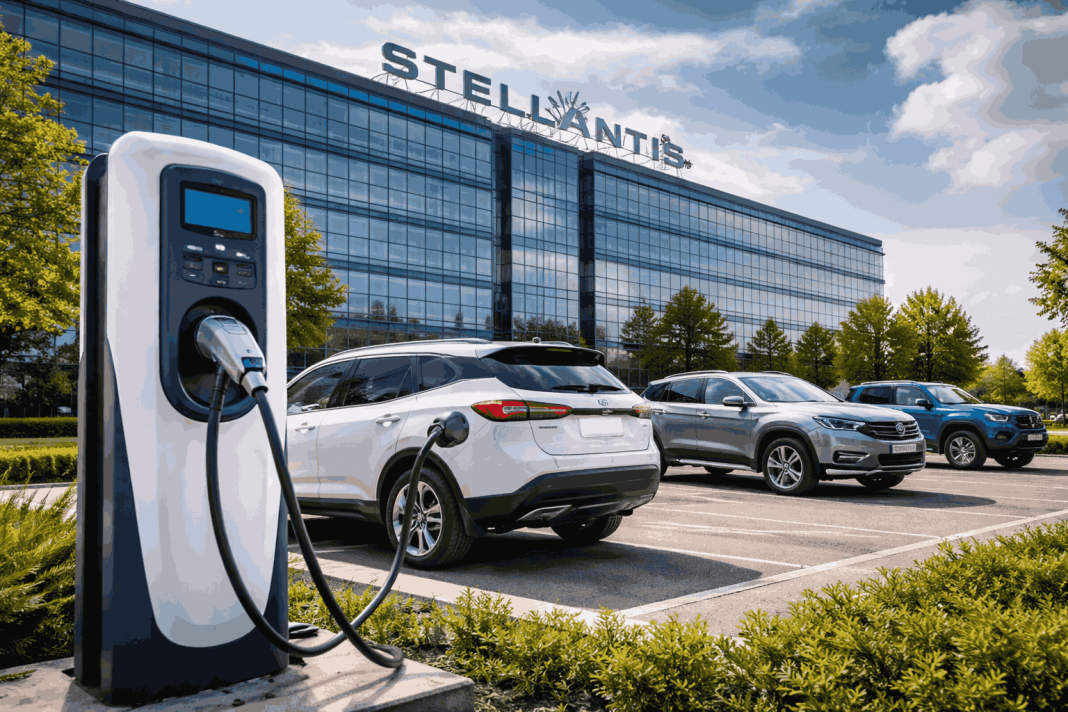
The Stellantis EV Overestimation has become one of the most striking financial recalibrations the global auto industry has seen in recent years. What began as an ambitious push toward rapid electric vehicle adoption has resulted in a staggering €22 billion charge, forcing Stellantis to pause dividends in 2026 and rethink its entire electrification roadmap.
This moment marks more than a balance-sheet correction. It highlights how quickly market optimism can clash with consumer reality, especially in a sector undergoing regulatory, technological, and economic change all at once.
Understanding the Financial Impact of Stellantis EV Overestimation
At the center of this reset is a €22 billion accounting charge announced by Stellantis, shocking investors and sending shares down nearly 19% in a single trading session. Of that total, approximately €6.5 billion represents actual cash outflows expected over the next four years, while the remaining €15 billion reflects reduced asset values tied to slower-than-expected EV demand.
This adjustment has had immediate consequences. Profit forecasts were slashed, dividend payments were suspended for 2026, and investor confidence took a visible hit. According to analysts, this move signals that Stellantis is prioritizing long term sustainability over short-term shareholder returns a painful but possibly necessary decision.
For broader financial context on the auto sector, you can explore our UK Economy Growth Surges as November Data Beats Forecasts.
Why Stellantis EV Overestimation Happened in the First Place
The root of the problem lies in timing. Stellantis assumed that EV adoption would accelerate rapidly across major markets, particularly in North America and Europe. Instead, consumer demand softened as high vehicle prices, limited charging infrastructure, and rising interest rates slowed purchasing decisions.
In the United States, policy changes played a major role. Reduced tax incentives and relaxed emissions rules dampened urgency for buyers to switch from internal combustion engines. Europe faced its own challenges, with uneven subsidy programs and growing cost-of-living pressures affecting consumer behavior.
As a result, production plans built around aggressive EV growth quickly became misaligned with real-world demand.
Canceled Projects Reflect Stellantis EV Overestimation
One of the clearest signs of this miscalculation has been the cancellation or scaling back of several high-profile projects. Stellantis shelved plans for the electric Ram 1500 pickup, a model once positioned as a flagship EV for the North American market. The company also sold its stake in a major Canadian battery manufacturing venture, signaling a pullback from capital-intensive commitments.
These decisions underscore how deeply the Stellantis EV Overestimation influenced long-term investments. Instead of doubling down, leadership opted to preserve cash and reduce exposure to uncertain demand curves.
For a global view of EV adoption trends, the International Energy Agency’s EV outlook offers valuable data on regional disparities.
Brand and Market Consequences Across Regions
Stellantis’ diverse brand portfolio spanning mass-market and premium segments has not been immune to the fallout. Market share slipped in both North America and Europe, prompting internal reviews of factory utilization and output levels.
Production cuts are now being considered in several plants as the company works to rebalance supply with actual demand. Analysts suggest this could lead to a leaner, more efficient manufacturing footprint, albeit with short-term disruptions for workers and suppliers.
For related insights, see our analysis of European auto manufacturing trends.
Executive Response to Stellantis EV Overestimation
Company leadership has openly acknowledged the strategic misstep. Executives described the charge as a “wake-up call,” admitting that planning became detached from customer priorities. Instead of focusing on affordability and practicality, the company leaned too heavily on regulatory assumptions and long-range forecasts.
This candid assessment has been welcomed by some investors, who view transparency as the first step toward rebuilding trust. The revised strategy now emphasizes flexibility, customer-driven development, and phased electrification rather than sweeping mandates.
Industry-Wide Lessons from Stellantis EV Overestimation
Stellantis is not alone. Other major automakers have reported multi-billion-euro EV losses over the past two years, highlighting an industry-wide struggle to balance innovation with profitability. These setbacks suggest that the transition to electric mobility will be more gradual and region-specific than originally projected.
The Stellantis EV Overestimation serves as a cautionary example: even the largest manufacturers must remain responsive to consumer sentiment, infrastructure readiness, and policy stability.
A Demand-Led EV Strategy Moving Forward
Rather than abandoning electrification, Stellantis is recalibrating. The company plans to prioritize hybrid models and affordable EVs that align with everyday driving needs. This approach allows consumers to transition at a comfortable pace while preserving profitability.
Factory investments will be reviewed market by market, and future EV launches will depend on proven demand rather than projected growth alone. While this slower rollout may disappoint some advocates, it could ultimately result in more sustainable progress.
Final Thoughts on Stellantis EV Overestimation
The €22 billion charge tied to the Stellantis EV Overestimation is a costly reminder that transformation without alignment can backfire. Yet, it also creates an opportunity. By shifting toward demand-led growth, Stellantis may emerge stronger, leaner, and more attuned to its customers.
For consumers, this could mean better-priced vehicles, improved product fit, and a more realistic path toward electrification. The road ahead remains challenging, but this reset may prove to be a turning point rather than a dead end.

Hello there! I’m Online Media & PR Strategist at BusinessFits | Passionate Journalist, Blogger, and SEO Specialist