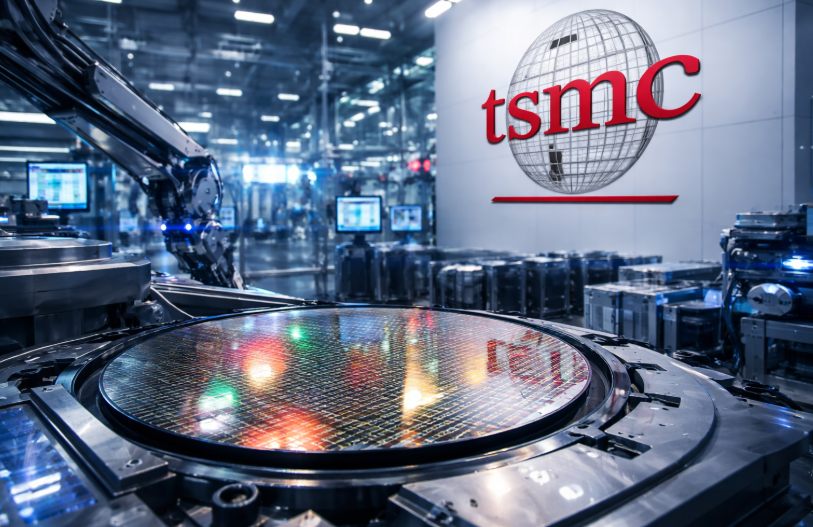
The latest earnings from TSMC confirm one thing: TSMC AI Demand is stronger than ever. The world’s leading chipmaker reported a massive $35.7 billion in first-quarter revenue, marking a 35% year-over-year increase. This performance directly counters fears of an artificial intelligence bubble and highlights sustained momentum across the semiconductor industry.
Investors had been cautious about a potential tech slowdown. However, these results show that demand for advanced chips especially those powering AI systems remains solid and growing. The numbers are not speculative; they reflect real orders and real expansion.
TSMC AI Demand Highlights Strong Financial Performance
The financial results tell a clear story. TSMC exceeded analyst expectations, continuing a streak of strong quarterly beats. Revenue growth of 35% year-over-year signals not just recovery, but acceleration.
A major driver behind this surge is the increasing need for AI chips. Companies like Nvidia rely heavily on TSMC’s advanced manufacturing capabilities to produce high-performance processors used in data centers and machine learning systems.
TSMC’s ability to meet demand at scale has positioned it at the center of the AI revolution. Its fabs are running at near full capacity, reflecting the urgency and scale of global orders.
For deeper insights into financials, visit the TSMC investor relations page.
TSMC AI Demand Powers Industry-Wide Growth
The impact of TSMC AI Demand extends beyond one company. Across the semiconductor ecosystem, similar growth patterns are emerging.
Nvidia reported record revenues, driven largely by its data center segment, which continues to expand rapidly. Meanwhile, Foxconn a key supplier of AI servers posted strong revenue gains as well.
Another major player, Broadcom, also reported impressive annual results, highlighting how AI infrastructure spending is lifting the entire sector.
These aligned growth trends suggest a coordinated expansion fueled by hyperscale cloud providers. Companies such as Amazon, Microsoft, and Alphabet continue to invest heavily in AI infrastructure, driving sustained chip demand.
TSMC AI Demand Challenges Bubble Concerns
Despite strong performance, some analysts remain cautious. Concerns about an AI-driven bubble persist, particularly given the scale of capital spending by major tech firms.
Investment levels are reaching historic highs. Estimates suggest that hyperscalers could spend nearly $700 billion on AI infrastructure in the coming years. This level of spending has drawn comparisons to the dot-com era.
Financial institutions like Morgan Stanley have pointed out that revenue growth for some tech giants is not keeping pace with their investment levels. Debt has also increased across companies like Meta and Amazon.
However, the consistent strength of TSMC AI Demand suggests that these investments are backed by real, growing needs rather than speculation. Over the past two years, actual AI spending has repeatedly exceeded forecasts, indicating that demand continues to surprise on the upside.
Benchmark Raises $225M to Bet Big on Cerebras AI Chips
TSMC AI Demand Reflects Real Market Needs
One key takeaway from this quarter is that demand is not hypothetical it is operational. Data centers require increasingly powerful chips to handle AI workloads such as training large language models and running complex algorithms.
TSMC’s advanced process technologies, including 3nm and 5nm nodes, are essential for these applications. This gives the company a competitive edge that is difficult to replicate.
The consistency of TSMC AI Demand also indicates long-term structural growth. Unlike short-term hype cycles, this demand is tied to foundational shifts in computing, automation, and digital services.
TSMC AI Demand and Stock Market Reaction
The stock market responded positively to the earnings report. Shares of TSMC rose approximately 2.3% following the announcement, adding to an already strong yearly performance.
So far this year, the company’s stock has gained nearly 30%, reflecting investor confidence in its role within the AI ecosystem. The steady rise suggests that markets are beginning to price in sustained growth rather than temporary spikes.
The broader semiconductor index also benefited, as strong results from TSMC often signal health across the entire sector.
TSMC AI Demand Outlook for the Future
Looking ahead, the outlook remains optimistic. TSMC is expected to release more detailed earnings guidance soon, which will provide additional clarity on future demand trends.
If current patterns continue, TSMC AI Demand will likely remain a key driver of revenue growth. The expansion of AI applications from cloud computing to autonomous systems suggests that chip demand will only increase.
At the same time, investors should monitor capital spending trends and macroeconomic conditions. While growth is strong, sustainability will depend on continued innovation and balanced investment strategies.
TSMC AI Demand Signals a New Tech Era
Ultimately, the latest results highlight a fundamental shift in the technology landscape. AI is no longer a niche segment it is a core driver of global economic activity.
The strength of TSMC AI Demand demonstrates that companies are not just experimenting with AI; they are building entire infrastructures around it. This transition is likely to shape the future of computing for years to come.
While debates about a potential bubble may continue, the data points to a different conclusion: real demand, real growth, and real impact.