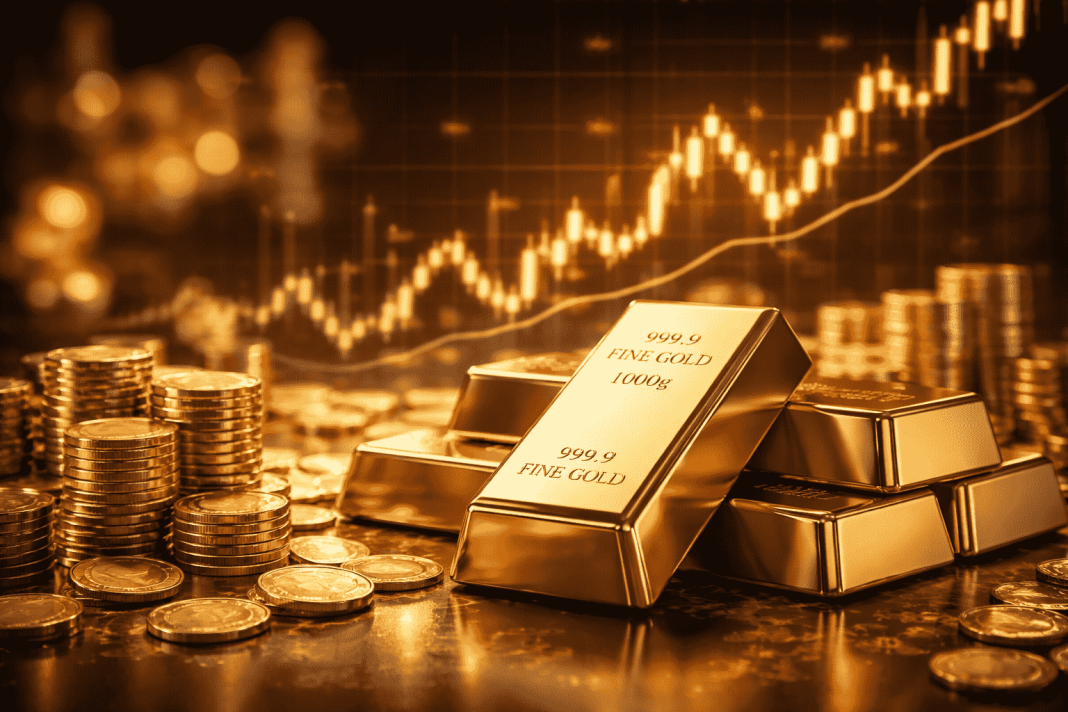
The Gold Price Surge in 2025 has captured global attention as gold crosses an unprecedented $4,400 per ounce. Investors, central banks, and market analysts are closely watching this historic rally, driven by interest rate expectations, geopolitical tensions, and currency weakness. As uncertainty grows across financial markets, gold is once again proving its value as a safe-haven asset.
This remarkable move is not happening in isolation. Silver, platinum, oil, and industrial metals are all responding to the same macroeconomic pressures, creating ripple effects across global commodities.
Understanding the Gold Price Surge in 2025
The Gold Price Surge reached its peak when spot gold briefly touched $4,420 per ounce before stabilizing. This marks the strongest annual performance for gold in decades, with prices rising nearly 68% year to date.
Silver followed with even stronger momentum, surging past $69 per ounce, supported by both investment demand and industrial usage. Platinum also recorded multi-year highs, while copper climbed above $12,000 per tonne due to supply constraints and trade concerns.
UK Investor Outlook: Navigating Global Economic Uncertainty
Key Economic Drivers Behind the Gold Price Surge
One of the most important catalysts behind the Gold Price Surge is the shifting monetary policy in the United States. Expectations of interest rate cuts by the US Federal Reserve in 2026 have reduced bond yields, making non-yielding assets like gold more attractive.
Additionally, the US dollar has weakened against major currencies, lowering gold’s price for international buyers. Central banks across Asia and the Middle East are increasing gold reserves to diversify away from dollar-based assets and hedge against inflation risks.
Geopolitical Risks Fuel the Gold Price Surge
Global instability continues to amplify the Gold Price Surge. Rising geopolitical tensions, including US sanctions and actions against Venezuela, have unsettled energy and currency markets.
Concerns over trade policies, political pressure on central bank independence, and renewed tariff discussions have increased safe-haven demand. Historically, such environments push investors toward assets that preserve value, with gold remaining the top choice.
For historical context, see this external resource from the World Gold Council.
How Its Impact on Oil Markets?
The Gold Price Surge has coincided with renewed volatility in oil prices. Brent crude rose to around $61 per barrel, while US crude climbed above $57, following concerns over oil supply disruptions linked to Venezuela.
Although oil prices may end the year lower overall, short-term spikes reflect geopolitical uncertainty. Energy markets often move alongside gold during periods of heightened global risk, reinforcing gold’s role as a market barometer.
Effects of the Gold Price Surge on Other Commodities
Beyond precious metals, the Gold Price Surge has influenced industrial commodities. Copper prices continue to rise due to supply shortages and strong infrastructure demand. Silver benefits from its dual role as both a safe-haven asset and a critical industrial metal used in renewable energy and electronics.
Platinum gains are supported by automotive demand and tightening supply chains. Together, these movements highlight how gold’s rally often signals broader shifts across the commodity spectrum.
What the Gold Price Surge Means for Investors
For investors, the Gold Price Surge is a signal to reassess portfolio diversification. Gold traditionally performs well during economic slowdowns, inflationary cycles, and geopolitical crises.
Central banks are leading the shift, but retail and institutional investors are following. Adding gold or gold-backed assets can help reduce volatility and protect purchasing power during uncertain times.
Gold Price Surge Breaks $4,000 Barrier in Historic Rally
Historical Perspective on the Gold Price Surge
Historically, gold’s strongest rallies occurred during periods of global stress, such as the late 1970s inflation crisis. The current Gold Price Surge mirrors those conditions, combining monetary uncertainty, political risk, and currency volatility.
What sets today apart is the scale of central bank participation and the interconnected nature of global markets, which can amplify both gains and corrections more rapidly than in past cycles.
Future Outlook
Looking ahead, analysts expect the Gold Price Surge to remain supported as long as interest rate cuts, geopolitical uncertainty, and currency weakness persist. Any escalation in global conflicts or delays in monetary tightening could push prices even higher.
While short-term corrections are possible, gold’s long-term outlook remains strong. Investors should stay informed, diversify wisely, and monitor global macroeconomic signals closely.