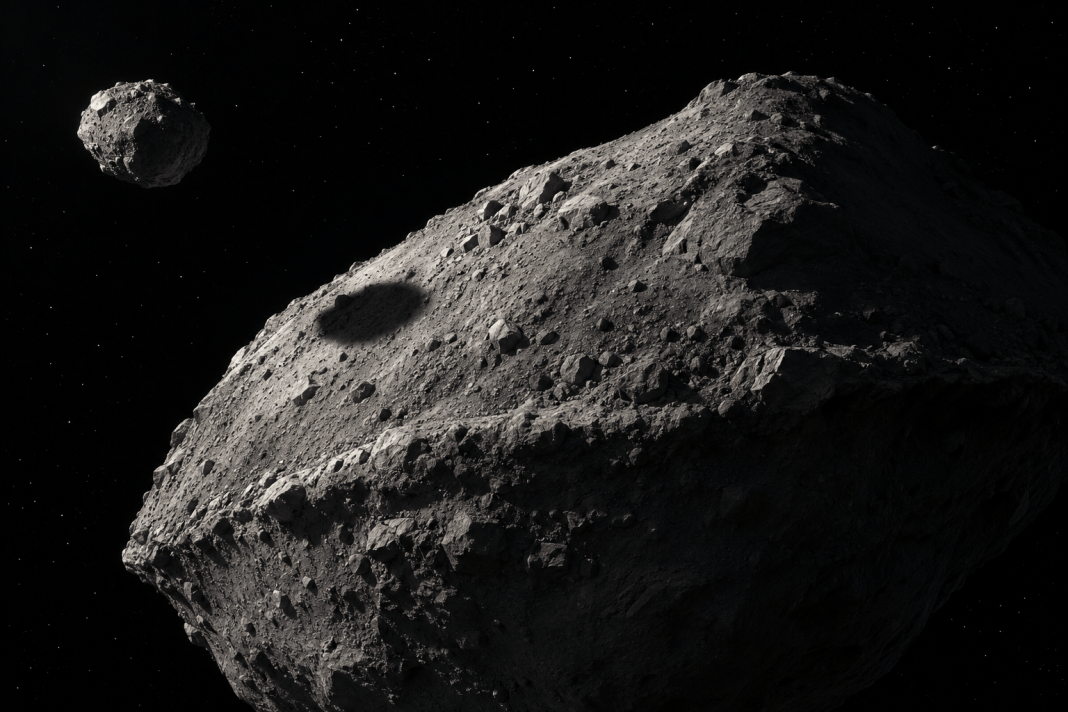
Hera Asteroid Mission Captures an Eclipse on Didymos
Imagine a tiny moon throwing a dark shadow across a spinning rock in deep space. The Hera asteroid mission captured that scene when Dimorphos passed between the Sun and part of Didymos. The solar eclipse gave scientists a front-row view of two asteroids that made history in a test of Earth’s planetary defences. See the asteroid eclipse image.
Back in September 2022, NASA sent a spacecraft called DART straight into Dimorphos. The crash shortened the time the moonlet takes to circle Didymos by about 33 minutes. Now Hera is close enough to examine the rocks and ridges for clues about what happened during the impact. Read about the DART results.
The eclipse gives us a familiar way into the story. Most of us can picture the Moon casting a shadow on Earth. But seeing the same thing happen on a rock small enough to spin once every few hours puts the scale of the mission into perspective.
How the Hera Asteroid Mission Sees Beyond Human Eyes
First, the Asteroid Framing Camera takes sharp black-and-white pictures for navigation and science. An image from about 28.5 kilometres away shows a ridge around Didymos’s middle, along with areas dotted with boulders. Researchers can use details like these to map the surface and find landmarks they can recognise in later images. Explore the close-up instrument views.
Next, an instrument called HyperScout H studies the sunlight that bounces off the rocks. It sorts that light into 25 bands, covering visible and near-infrared wavelengths. Different minerals reflect light in different ways, so the team can compare those patterns with known samples. That gives researchers a way to look for changes in surface composition across the two rocks. Read how Hera’s instruments work.
Finally, the Thermal Infrared Imager picks up heat given off by the asteroids. In one set of images, almost all of Dimorphos is in shadow in the visible view. Its shape still shows up in infrared because the surface continues to release heat. The colours in the thermal image mark temperature differences.
That heat can tell scientists something about the ground beneath the camera. Fine grains tend to change temperature faster than solid rock. By tracking how quickly a patch warms or cools, the team can estimate whether it holds loose material or larger pieces of rock.
What the Hera Asteroid Mission Saw During the Eclipse
Picture yourself on Didymos as the small moon crosses in front of the Sun. For a short time, Dimorphos blocks direct sunlight from reaching the stretch of ground beneath its shadow. The same alignment causes a solar eclipse on Earth, where the Moon passes in front of the Sun and casts a shadow.
The scale is what makes the scene so striking. Dimorphos is about 151 metres across and orbits roughly a kilometre from Didymos. The moonlet can cast a noticeable shadow on the larger body because the two are so close together.
Didymos also spins about once every 2.2 hours. With such weak gravity and a surface turning that quickly, even sitting still to watch the eclipse would be difficult. Scientists suspect that the rapid spin may help move loose material towards the equator, where the ridge circles the asteroid.
The eclipse view and the thermal view tell two different parts of the story. In the eclipse picture, the dark patch is on Didymos. In the thermal comparison, most of Dimorphos itself lies in shadow. Jump back to how Hera’s cameras see in shadow.
Why the Hera Asteroid Mission Matters for Planetary Defence
First, researchers want to know why the DART crash gave Dimorphos a bigger push than early models predicted. The spacecraft transferred momentum when it struck. Then debris flew away from the impact site, adding to the push. A better estimate of the moonlet’s mass will help the team work out how much momentum the debris carried away.
The orbital change gave scientists one clear result. Scientists can use that shorter orbit as a reference when they compare their computer models with what Hera sees. Finding out how much material moved, and where it ended up, will help researchers explain how a single collision produced that change. Read about Hera’s survey plans.
Next, the close-up survey will look for signs of a crater or a wider change in the moonlet’s shape. Those outcomes would tell researchers different things about how tightly the rocks that make up Dimorphos hold together. Two small companion spacecraft will join the survey, giving the team another way to study the pair from close range.
Those details could matter if a future mission ever needs to nudge an asteroid away from Earth. Engineers would need to estimate how a particular asteroid might react and how early the spacecraft would need to hit it. Over time, even a small change in an asteroid’s path can add up. Knowing more about the target would help engineers judge how much of a push it needs.
The team can also compare the two asteroids as it builds up its maps. DART struck Dimorphos, yet some of the debris may have crossed the gap to Didymos. If researchers find signs of that material on the larger asteroid, it could help them trace where the debris went after the collision. Read about the first close-up views.
For now, the eclipse offers a striking look at the same asteroid pair that made the experiment possible. A tiny moon can cast a shadow over its larger neighbour as it circles, just as our own Moon does. The next close-up surveys will help explain how that orbit changed when a spacecraft crashed into it.

Nuwan Wackwella is a digital creator passionate about technology, creativity, and sharing inspiring moments from everyday life.