Table of Contents
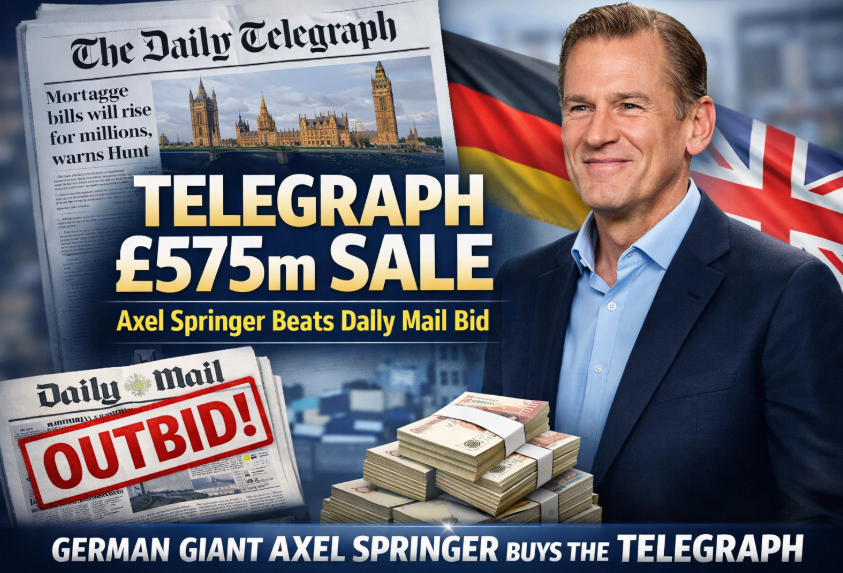
ToggleThe Telegraph £575m Sale marks one of the biggest shake ups in the British media industry in recent years. After years of uncertainty over ownership, the historic UK newspaper group has finally found a new owner. German publishing giant Axel Springer has secured the deal, beating rival bidders including the Daily Mail’s parent company.
The acquisition signals a major shift in the UK media landscape, bringing new investment, global ambitions, and advanced digital strategies to one of Britain’s most influential newspapers.
The Telegraph Media Group, publisher of The Daily Telegraph and The Sunday Telegraph, has long been a key voice in British journalism. With the Telegraph £575m Sale now agreed, the future direction of the publication is set to change significantly.
Telegraph £575m Sale: How the Deal Happened
The Telegraph £575m Sale came after a complex and lengthy ownership process that began nearly three years ago. The situation started when the Barclay family, long-time owners of the newspaper group, faced mounting debts totaling more than £1 billion.
When those debts could not be repaid, lenders stepped in. Lloyds Bank took control of the Telegraph titles in an effort to recover the outstanding £1.16 billion owed by the Barclay family.
Eventually, investment firm RedBird IMI paid off those debts and temporarily gained control of the newspaper group. However, new UK government regulations created obstacles. These rules limited foreign state-backed ownership of British media companies to protect editorial independence.
Because RedBird IMI had financial backing linked to UAE investors, the government required the company to sell the asset again. That requirement ultimately opened the door for Axel Springer to enter the bidding process and secure the deal.
Telegraph £575m Sale: Axel Springer’s Winning Bid
The Telegraph £575m Sale was finalized when Axel Springer offered £575 million in cash for the Telegraph Media Group, beating competing bids from several interested parties.
Axel Springer is one of Europe’s largest media companies and already owns well-known brands including Politico, Business Insider, and the German newspaper Bild. The company has a strong focus on digital journalism and global expansion.
Chief executive Mathias Döpfner described the acquisition as a long-held ambition. Axel Springer had attempted to purchase the Telegraph before but was unsuccessful at the time. This time, however, the opportunity aligned perfectly with the company’s strategy.
According to Döpfner, the Telegraph’s reputation, readership, and political influence make it an ideal addition to Axel Springer’s international media portfolio.
For more details about the company’s global media strategy, visit the official Axel Springer website.
Telegraph £575m Sale: Daily Mail Loses the Bid
The Telegraph £575m Sale also highlights the fierce competition surrounding the purchase. Daily Mail and General Trust (DMGT), the parent company of the Daily Mail, had previously submitted a strong bid estimated at around £500 million.
DMGT hoped to bring the Telegraph titles under British ownership and argued that its experience in running large newspaper brands made it a strong candidate.
However, regulators raised concerns about media concentration and competition within the UK news market. The government launched reviews into the potential impact of the acquisition on media plurality.
Although DMGT publicly criticized the regulatory framework, calling parts of it outdated, the company ultimately lost the race to Axel Springer’s higher offer.
Telegraph £575m Sale: Impact on the Newspaper’s Future
The Telegraph £575m Sale could significantly influence the future direction of the publication. Axel Springer has made it clear that its strategy will focus heavily on digital growth and international expansion.
One key priority is increasing the Telegraph’s presence in the United States. The company believes the paper’s political positioning and strong journalism could attract a wider global audience, particularly among English-speaking readers.
Axel Springer has already achieved success expanding digital subscriptions across its media brands. Executives expect similar growth opportunities for the Telegraph through online readership, multimedia journalism, and new technology tools.
Another important focus will be artificial intelligence and data-driven publishing. The company plans to integrate AI technologies to improve news production, audience engagement, and digital product development.
Despite these technological plans, Axel Springer leaders have emphasized that editorial independence will remain protected.
Telegraph £575m Sale: What It Means for UK Media
The Telegraph £575m Sale carries broader implications for the British media landscape. Ownership changes at major newspapers often influence the direction of journalism, political commentary, and media competition.
The Telegraph currently employs around 900 staff members, including roughly 400 journalists working across the daily and Sunday titles. For many employees, the deal brings relief after several years of uncertainty.
Industry experts say the acquisition reflects a wider trend in global media. Large international companies are increasingly acquiring established publications in order to expand digital readership and global influence.
In this case, ownership of a major British newspaper has moved from a UK family business to a large European media corporation. While some observers see this as a positive sign of investment and innovation, others continue to debate the impact of foreign ownership on British journalism.
Conclusion
The Telegraph £575m Sale brings an end to a long and complicated ownership saga that began with financial troubles and regulatory hurdles. Axel Springer’s successful bid now positions the company to reshape one of Britain’s most influential newspapers.
With plans for digital expansion, new technology, and international growth, the Telegraph could enter a new phase of development under its German owner.
For readers, journalists, and the wider media industry, the Telegraph £575m Sale represents more than just a business transaction. It marks a pivotal moment in the evolution of modern journalism and the global competition for influential news brands.