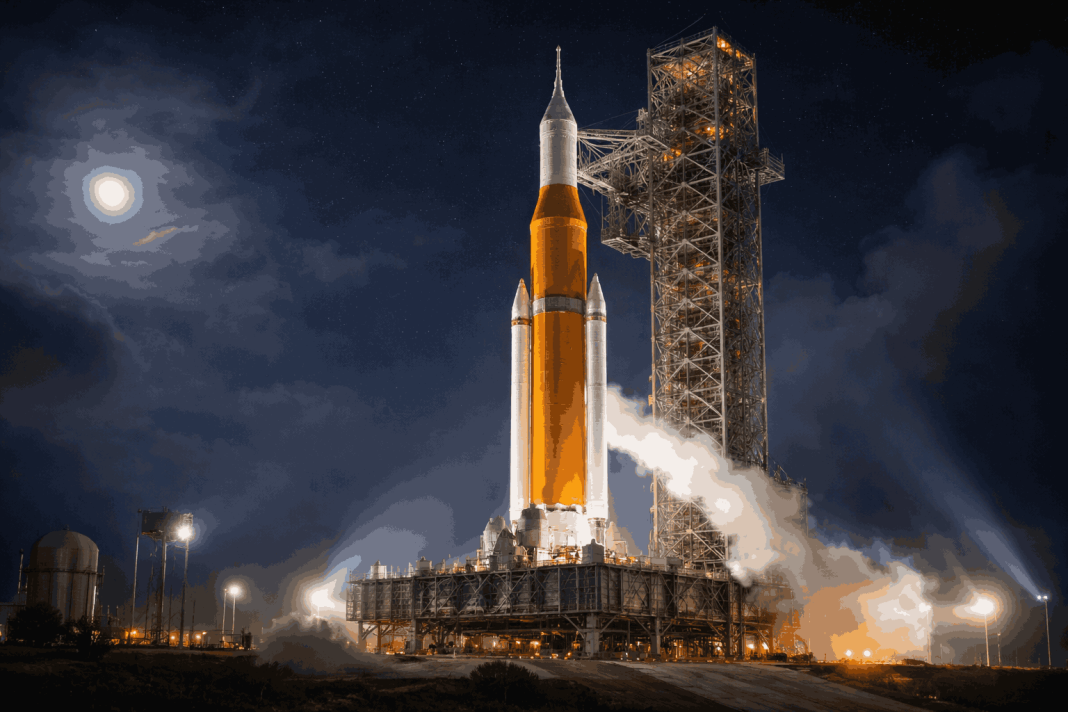
The Artemis II Mission represents NASA’s bold return to human deep-space exploration, but recent cold weather has introduced new scheduling challenges. As NASA prepares for its first crewed lunar flyby since the Apollo era, teams are navigating environmental delays while keeping safety and precision at the forefront. The current focus is completing the critical wet dress rehearsal, a full launch countdown simulation, now targeted for early February 2026.
This mission is a defining step toward sustained lunar exploration and future journeys to Mars. While delays can test patience, they also demonstrate NASA’s commitment to getting every detail right before humans venture beyond low Earth orbit once again.
Why Cold Weather Delayed the Artemis II Mission Timeline
Unseasonably cold temperatures caused by an arctic weather system moving through Florida forced NASA to postpone key pre-launch tests. The wet dress rehearsal—where the Space Launch System (SLS) rocket is fully fueled—requires stable environmental conditions to protect hardware and ensure accurate data collection.
NASA engineers closely monitor wind speeds, temperature thresholds, and moisture levels at Kennedy Space Center. Even small deviations can impact sensitive systems within the Orion spacecraft. As a result, NASA shifted the tanking test to February 2, allowing teams additional time to verify heaters, valves, and ground support equipment.
These weather-driven delays are common in spaceflight and reflect a safety-first approach. According to official updates from NASA’s Artemis Program, managers will not proceed until all conditions meet strict launch criteria.
Wet Dress Rehearsal and Artemis II Mission Readiness
The wet dress rehearsal is the final major milestone before launch approval. During this test, more than 730,000 gallons of liquid hydrogen and liquid oxygen are loaded into the SLS rocket. Engineers then conduct a full countdown, stopping just seconds before ignition.
For the Artemis II Mission, this rehearsal validates fueling procedures, countdown timing, communication systems, and emergency protocols. It also allows NASA to gather data on how the rocket and spacecraft respond under real launch conditions.
Live coverage of the rehearsal is expected through NASA TV, offering the public a rare look at preparations for human spaceflight. If the rehearsal proceeds without major issues, mission managers will confirm a launch readiness review shortly afterward.
Meet the Crew Flying the Artemis II Mission
Four astronauts from two nations will fly aboard Orion on this historic journey. NASA astronaut Reid Wiseman serves as commander, bringing prior spaceflight experience. Victor Glover is the pilot, while Christina Koch joins as a mission specialist, building on her record-setting long-duration stay aboard the International Space Station.
Completing the crew is Jeremy Hansen from the Canadian Space Agency, marking the first time a Canadian astronaut will travel around the Moon. This international collaboration highlights the global nature of modern space exploration and strengthens long-term partnerships.
The crew remains in active training and quarantine protocols as NASA finalizes timelines. More crew background details are available through the Canadian Space Agency.
Mission Path, Objectives, and Artemis II Mission Duration
Following launch, the Artemis II Mission will follow a free-return trajectory, looping around the Moon without entering lunar orbit. The mission is expected to last approximately 10 days, during which astronauts will travel nearly 4,600 nautical miles beyond the far side of the Moon farther than any humans have gone before.
Key objectives include testing life-support systems, navigation, propulsion, and deep-space communication technologies. Astronauts will also observe the Moon’s far side and evaluate Orion’s performance during high-speed reentry into Earth’s atmosphere.
Data collected will directly inform future missions, including lunar landing attempts and long-duration exploration beyond Earth.
How Artemis II Builds on Artemis I Success
NASA’s uncrewed Artemis I mission in 2022 proved that the SLS rocket and Orion capsule could safely travel to the Moon and back. However, flying humans introduces additional complexity, from environmental control to emergency response planning.
The Artemis II Mission serves as the bridge between testing hardware and landing astronauts on the lunar surface. It validates systems under real operational conditions and ensures astronauts can safely operate in deep space before committing to surface missions.
What Comes After the Artemis II Mission
Success here paves the way for Artemis III, which aims to land astronauts near the Moon’s south pole later this decade. Long term goals include establishing a sustainable lunar presence, developing the Lunar Gateway, and using the Moon as a proving ground for Mars missions.
NASA continues to publish updates through its official Artemis Blog, offering insights into timelines, technology, and exploration strategy.
Why the Artemis II Mission Matters Globally
Beyond technical achievements, the Artemis II Mission carries symbolic weight. It marks humanity’s return to deep space, inspires future scientists and engineers, and reinforces peaceful international cooperation in exploration.
Delays may shift dates, but they also underscore the discipline required for human spaceflight. Every adjustment ensures that when astronauts finally lift off, they do so with maximum confidence and safety.
As countdown preparations continue, global attention remains fixed on Kennedy Space Center waiting for the moment humans once again journey toward the Moon.