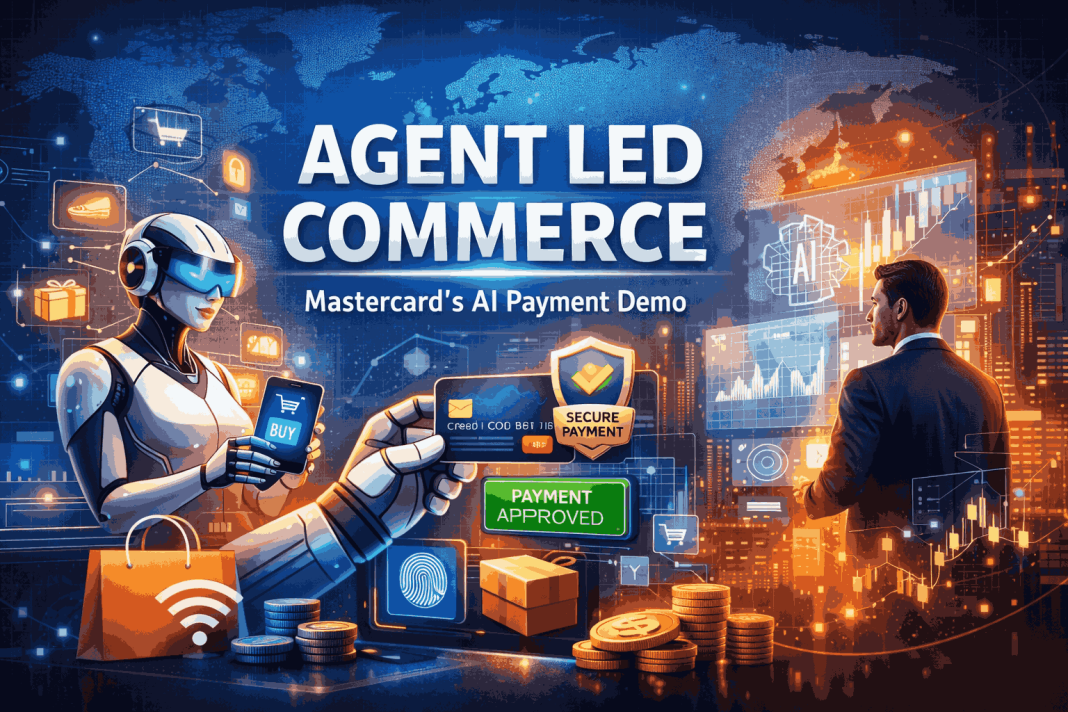
The rise of Agent Led Commerce is transforming how people buy online, and Mastercard’s latest AI payment demo highlights this shift clearly. Instead of shoppers manually browsing, comparing, and checking out, AI agents can now handle the entire purchase process. This innovation shows a future where digital commerce runs quietly in the background while users simply define preferences, budgets, and rules.
Mastercard revealed a concept where an AI agent searches for products, evaluates website safety, and completes transactions using stored credentials. The idea moves beyond one-click payments into a “no-click” experience. Businesses, banks, and regulators are watching closely because automated commerce could change customer journeys, security models, and even marketing strategies.
How Agent Led Commerce Works in Mastercard’s Demo
Mastercard’s AI showcase demonstrated a controlled scenario where an AI agent completed a purchase autonomously. The agent browsed an online store, verified the merchant’s authenticity, and used tokenised card data to finalize payment securely. Users did not need to enter card details or open payment apps.
The process relied on pre-approved permissions. For example, spending limits and trusted merchant lists ensured the AI acted responsibly. Security layers verified both the user identity and the agent’s authorization before any transaction was approved.
Unlike traditional automation tools, this system blends advanced AI reasoning with existing payment infrastructure. The goal is to maintain strong compliance while introducing a seamless purchasing experience. Businesses exploring this concept can learn more from Mastercard’s official insights.
Benefits of Agent Led Commerce for Businesses and Consumers
For consumers, the biggest advantage is convenience. AI agents can compare prices, monitor deals, and complete purchases faster than humans. Tasks such as subscription renewals or routine product orders become automated, saving time and reducing friction.
Companies also benefit from this shift. Retailers could gain consistent conversions because AI buyers follow logical decision paths rather than emotional ones. Merchants that optimize product data and APIs may see improved visibility in AI-driven marketplaces.
Finance teams inside enterprises may use automated procurement agents to manage supply orders efficiently. Clear spending rules, audit logs, and machine decision tracking make it easier to monitor expenses.
Security Challenges in Agent Led Commerce Systems
While automation offers speed, it also introduces new risks. Hackers may attempt to exploit AI agents or manipulate purchasing rules. Fraud detection systems must evolve to monitor not just human behavior but also machine patterns.
Mastercard’s approach focuses on tokenisation and layered authentication. Instead of exposing real card numbers, transactions rely on secure tokens linked to verified identities. This reduces the risk of data breaches during automated purchases.
However, regulators will likely demand strict transparency. Businesses must define who is responsible if an AI makes a wrong purchase or violates policy. Governance frameworks and continuous monitoring will be essential as AI moves deeper into payment ecosystems.
Technology Behind Agent Led Commerce Payment Automation
The demo used stored credentials within a closed environment to ensure safety during testing. In real-world deployments, payment networks must collaborate with fintech platforms, banks, and e-commerce systems to maintain compatibility.
AI agents combine natural language processing, risk assessment models, and payment authorization APIs. These tools allow the agent to evaluate websites, confirm product legitimacy, and process transactions within seconds. Developers may need to design AI-friendly storefronts where product data is structured and accessible.
Industry analysts predict that APIs will become a key battleground. Retailers with fast, machine-readable product catalogs could gain an advantage in automated buying environments.
Business Strategy for Agent Led Commerce Adoption
Organizations should begin preparing now, even if widespread adoption takes time. Updating digital infrastructure is a major step. Payment systems must support tokenisation, AI authentication, and real-time decision tracking.
Legal teams must also rethink policies around liability and consent. When an AI agent represents a user or company, agreements need to clarify who approves transactions and how disputes are handled. Training staff on AI governance will help businesses adapt faster.
Marketing strategies may shift as well. Instead of targeting human emotion alone, brands may need to optimize product data so AI agents can evaluate value, reliability, and pricing more effectively. Companies that understand machine-driven commerce early may gain a strong competitive edge.
Future Outlook of Agent Led Commerce in Global Payments
The Mastercard demo suggests that AI is moving from assistant to operator. Rather than recommending products, AI agents may soon execute purchases end-to-end. Checkout pages could disappear entirely, replaced by automated payment authorization running behind the scenes.
Banks and regulators must approve new frameworks before large-scale deployment becomes reality. Privacy concerns, ethical AI use, and cross-border regulations remain key challenges. Still, the direction is clear: commerce is becoming more autonomous and data-driven.
As ecosystems evolve, businesses may build digital storefronts designed specifically for AI interaction. This could lead to faster transactions, smarter pricing models, and new opportunities for personalized services.
Why Agent Led Commerce Matters Right Now
The concept represents more than a single demo it signals a shift in how digital economies operate. Companies that ignore AI-driven purchasing risk falling behind competitors that optimize for automated decision-making.
Consumers will likely see smoother buying experiences, fewer repetitive tasks, and improved security through tokenisation. Enterprises gain efficiency, while payment networks strengthen their role in managing trust and compliance.
In summary, Mastercard’s AI experiment demonstrates how automation is redefining online transactions. As AI agents become trusted participants in commerce, businesses must rethink infrastructure, security, and customer engagement strategies to stay relevant in this new era.

I’m an Online Media & PR Strategist at BusinessFits, passionate about digital storytelling and media impact. As a journalist, blogger, and SEO specialist, I create content that connects, informs, and ranks.